
Enhancing Household and Similar Waste (HSW) Management: Implementing a home Composting System in Jendouba and Kasserine
In Tunisia, the municipalities of Jendouba and Kasserine have implemented pilot home composting projects as part of their respective partnerships with the German cities of Wolfsburg and Munich, with the support of “City-to-City Cooperation Maghreb-Germany” regional project (KWT II). The projects aimed to improve the management of Household and Similar Waste (HSW) and soil quality by developing a replicable composting-based waste recovery system, while introducing residents to the circular economy as a driver of agricultural development and environmental protection.
Tags: Composting | Waste Management | Circular Economy | Household and Similar Waste (HSW) | Waste Recovery | Soil Fertilization | Jendouba | Kasserine | Tunisia | Decentralized Cooperation | Civil Society | KWT II | GIZ
Challenges addressed
- Need to strengthen the capacities and mobilization of municipal stakeholders in implementing project activities (municipal level)
- Budget constraints: in Jendouba, funds allocated for the purchase of compost bins were reallocated to other priority expenditures
- Difficulty in maintaining the long-term commitment of beneficiary households, due to limited engagement at the municipal level (citizen level)
- Need to mobilize civil society to support and strengthen municipal action on the ground
- The Jendouba project was limited to the first three methodological steps due to budget constraints
- Insufficient awareness among households of the added value of composting prior to project launch
Main objectives
- Improve the integrated management of Household and Similar Waste (HSW) in the two municipalities
- Provide households with compost bins to convert biodegradable waste into high-quality compost
- Develop a replicable composting-based waste recovery system
- Introduce residents to circular economy and improve the fertility of agricultural soils in the region
- Engage civil society organizations and educational institutions in awareness-raising and monitoring activities
Facts
Project Type
Pilot Home Composting Project and Circular Economy Awareness Program
Partnership
Municipalities of Jendouba and Kasserine (Tunisia) | Cities of Wolfsburg and Munich (Germany) | Deutsche Gesellschaft für Internationale Zusammenarbeit (GIZ) – KWT II Regional Project | Directorate General for External Relations and Decentralized International Cooperation, Ministry of Interior (Tunisia) | Engagement Global gGmbH / Service Agency Communities in One World (SKEW) | Local associations (Green Kasserine)
Funding
German Federal Ministry for Economic Cooperation and Development (BMZ). Estimated at: 7,000 EUR (Jendouba) + ≈ 13,000 EUR (Kasserine)
Duration
Surveys, awareness-raising, and training: 6 months
Procurement, distribution, and monitoring (Kasserine) | KWT II: March 2020 – February 2024
Location
Municipalities of Jendouba and Kasserine, Tunisia
Scaling up
Follow-up regional project “Urban Adaptation to Climate Change in the Maghreb” (March 2024 – February 2027)
Project description
These two pilot home composting projects are based on decentralized cooperation partnerships linking Kasserine with Munich and Jendouba with Wolfsburg, respectively.
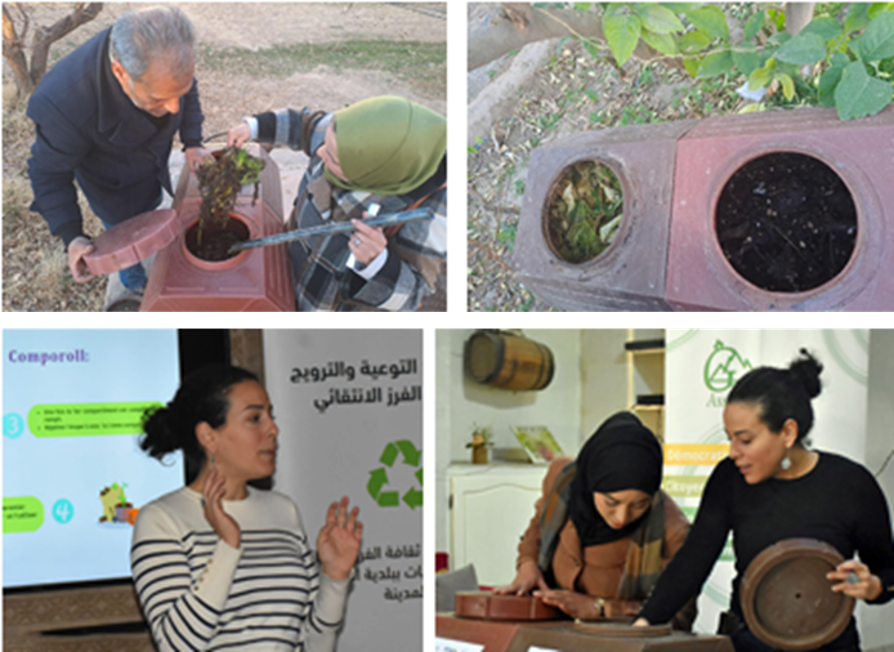
The project followed a structured six-step approach in Kasserine and a three-step approach in Jendouba. The first step consisted of household surveys for the selection of beneficiaries, followed by an awareness-raising and information campaign targeting households and students, with the involvement of neighborhood associations and schools. Training was then provided to beneficiaries, including citizens, civil society organizations and municipal staff, as well as composting ambassadors.
In Kasserine, the subsequent steps included the procurement and distribution of compost bins and dedicated waste bins, the provision of composting guides, and door-to-door support provided by a working group from the municipal sanitation department and civil society. In Jendouba, due to budget constraints, the municipality was unable to purchase compost bins, but some training participants practiced pile composting at home thanks to the skills they had acquired.
Both projects were implemented in close cooperation with the German partner cities, through in-person and virtual exchanges focusing on waste management and the circular economy approach.
Impact and results
Results Achieved
- In Jendouba: approximately 30 participants trained, improving their knowledge of organic waste and composting.
- In Kasserine: training and awareness-raising for approximately 40 citizens and 100 students.
- Awareness-raising campaigns conducted in both cities, targeting residents as well as schools and higher education institutions.
- Bringing together local stakeholders involved in the circular economy in Kasserine and creating a shared platform for exchange.
- Improved agricultural soil fertility through the use of the compost produced to nourish plants, while strengthening climate resilience to soil erosion.
- Promotion of waste recovery and citizen engagement in the transition towards a circular economy.
Lessons Learned
- Build on existing experience: Draw on the experience of the cities of Wolfsburg and Munich to adapt German good practices to the Tunisian context.
- Actively engage civil society organizations: Their role is crucial in implementation, monitoring and providing support to citizens.
- Generate own-source revenue: Municipalities must look for ways to finance improvements to their sanitation services.
- Ensure municipal commitment throughout all project phases and plan for close engagement with citizens at the local level.
Sorry, no posts matched your criteria.