
Towards Participatory Local Governance: Establishing a Citizen Space in Tlemcen
The Municipality of Tlemcen embarked on an innovative project aimed at establishing an inclusive Citizen Space, both physical and virtual. Launched in 2019 at the initiative of the President of the Municipal People’s Assembly, elected representatives and municipal officials, the project aimed to facilitate access to information on municipal services, reduce processing times for citizens’ requests, and optimize consultation sessions between municipal departments and residents. It is part of Strategic Area No. 3 of the municipality’s digital transition strategy, developed in 2020.
Tags: Citizen Space | Local Governance | Citizen Participation | Digitization | Municipal Services | Touchscreen Kiosk | Participatory Assessment | Tlemcen | Algeria | KWT II | GIZ
Challenges addressed
- Difficulty coordinating and sharing information among the various municipal departments
- Making furniture for the reception area: proposals that did not meet the required quality standards
- Need for continuous monitoring by technical advisors from the Deutsche Gesellschaft für Internationale Zusammenarbeit (GIZ) during the furniture manufacturing process
- Lack of digital literacy within some municipal departments at the outset
- Need to harmonize administrative information scattered across different municipal departments
- Challenge of ensuring citizen adoption of the digital component of the Citizen Space
Main objectives
- Facilitate citizens’ access to information on municipal procedures and services
- Reduce the processing time for requests submitted by citizens
- Optimize consultation sessions between municipal departments and citizens
- Centralize information on administrative procedures through a single access point
- Strengthen the capacity of municipal officials in local governance, citizen participation and digitization
Facts
Project Type
Establishing a Physical and Virtual Citizen Space as Part of a Digital Transition Strategy
Partnership
Municipality of Tlemcen (Algeria) | GIZ – “City-to-City Cooperation Maghreb-Germany” regional project (KWT II) | National Urban Planning Agency (ANURB), Ministry of Housing, Urban Planning, and Cities (Algeria) | Engagement Global gGmbH / Service Agency Communities in One World (SKEW) | Local associations
Funding
German Federal Ministry for Economic Cooperation and Development (BMZ)
Duration
Capacity building and participatory assessment: launched in 2019
Rollout of the Citizen Space: 4 years | KWT II: March 2020 – February 2024
Location
Tlemcen Urban Municipality, Tlemcen Region, Algeria
Scaling Up
Follow-up regional project “Urban Adaptation to Climate Change in the Maghreb” (March 2024 – February 2027)
Project description
This digital transition strategy is structured around three pillars: capacity building, the introduction of digital tools, and a communication campaign.
The first step consisted of training sessions and workshops aimed at strengthening the skills of technical and administrative staff and elected representatives in local governance, citizen participation, digitization and communication tools. The training followed a “learning by doing” approach, allowing for the immediate application of the skills acquired.
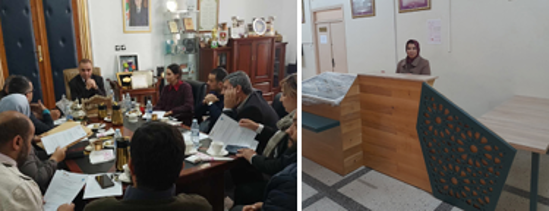
The second step involved a participatory and inclusive needs assessment conducted with more than 200 participants, including elected representatives, technical staff and citizens, through interviews and questionnaires. The assessment aimed to identify the most frequently requested services and information, challenges related to receiving citizens and processing their requests, as well as citizens’ needs and the obstacles they encounter when carrying out administrative procedures. A report summarizing the findings was prepared and served as a reference for all municipal departments.
Based on the findings of the assessment, the third step consisted of establishing the physical and virtual Citizen Space: a modern reception desk equipped with an application accessible through an interactive touchscreen kiosk, with trained staff responsible for guiding citizens and verify the compliance of their files. A communication strategy was also implemented across various channels, including local radio, social media, newspapers and posters, to reach different target groups, particularly women, young people and senior citizens.
Impact and results
Results Achieved
- 40 people (elected officials, technical and administrative staff) trained in local governance, citizen participation and digitization.
- Physical Citizen Space established: two reception desks, a waiting area, and an intuitive application accessible through an interactive touchscreen kiosk.
- Information on frequently requested administrative procedures centralized through a single access point for citizens.
- Summary report of the inclusive needs assessment developed, harmonizing information across all municipal departments.
- First initiative of its kind in Algeria, combining a physical and virtual space for citizen participation.
- Reduced workload for municipal staff through centralized data and the prior guidance of citizens.
Lessons Learned
- Adopt a participatory and inclusive approach: actively involve municipal staff and citizens, particularly during the needs assessment phase, to address users’ actual needs.
- Tailor capacity building to the needs of municipal teams by following a “learning by doing” approach to ensure rapid ownership of the project.
- Develop a multi-channel communication strategy to build citizens’ trust and ensure their engagement throughout the project lifecycle.
- Design a user-centric solution: an inclusive, participatory assessment ensures that the project effectively meets the real needs of citizens.
Sorry, no posts matched your criteria.