Citizen Participation for a Local Circular Economy in Mostaganem and Constantine
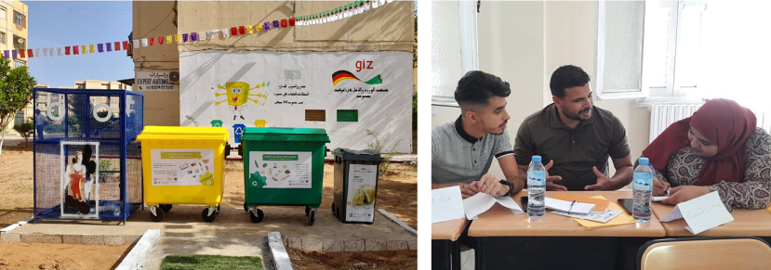
In Algeria, the municipalities of Mostaganem and Constantine implemented pilot waste sorting at source and integrated waste management initiatives in targeted neighborhoods as part of their respective partnerships with the Rhine-Neckar District and the City of Aschaffenburg. The approach involved engaging civil society organizations, citizens and neighborhood committees in the pre-collection and sale of recoverable waste fractions, with the revenue generated being used to fund the maintenance and servicing of the neighborhoods.
Tags: Sorting at Source | Circular Economy | Waste Management | Citizen Participation | Civil Society | Waste Recovery | Mostaganem | Constantine | Algeria | Decentralized Cooperation | KWT II | GIZ
Challenges addressed
- Identification of economic operators willing to collaborate with small quantities of sorted waste fractions
- Need to raise awareness among local stakeholders and citizens of the importance of selective waste sorting
- Coordination challenges among multisectoral partners, with roles not clearly defined
- Selection of pilot neighborhoods: difficulties in applying the pre-established selection criteria
- Challenges related to the storage of sorted materials (plastic bottles) and their protection from informal waste collectors
- Cultural challenges related to residents’ adoption of new waste-sorting practices
Main objectives
- Engage civil society organizations in the transition towards a circular economy at the local level
- Reduce the quantities of waste sent to landfills
- Create a source of income for organizations through the sale of recoverable waste fractions
- Improve residents’ living environment through the revenue generated from waste recovery
- Contribute to reducing municipal waste management costs
Facts
Project Type
Pilot project on waste sorting at source and integrated waste management with citizen participation
Partnership
Municipalities of Mostaganem and Constantine (Algeria) | Rhine-Neckar District, through its public-law institution AVR Kommunal in Sinsheim (Germany) | City of Aschaffenburg (Germany) | Deutsche Gesellschaft für Internationale Zusammenarbeit (GIZ) – “City-to-City Cooperation Maghreb-Germany” regional project (KWT II) | National Urban Planning Agency (ANURB), Ministry of Housing, Urban Planning and the City (Algeria) | Engagement Global gGmbH / Service Agency Communities in One World (SKEW) | Associations, neighborhood committees, wilaya directorates, schools
Funding
German Federal Ministry for Economic Cooperation and Development (BMZ) |
Duration
Planning and implementation: 12 to 18 months
Monitoring and evaluation | KWT II: March 2020 – February 2024
Location
Chemouma Housing Complex (320 units) (Mostaganem) and the Mimosa and Boumerzoug Housing Complexes (Constantine), Algeria
Scaling Up
Follow-up regional project “Urban Adaptation to Climate Change in the Maghreb” (March 2024 – February 2027)
Project description
The approach implemented in Mostaganem and Constantine was based on a structured participatory process, involving civil society organizations and neighborhood committees in the operational management of waste.
The project was structured around three phases. The first phase, focusing on reflection and planning, involved establishing a steering committee, identifying potential partners, defining the objectives and waste fractions to be sorted, selecting pilot neighborhoods based on a set of predefined criteria, and developing an implementation plan and communication strategy. The roles of each partner were clearly defined at this stage. Regular expert exchanges took place between the Algerian cities and their German partners.
The second phase, focusing on implementation, included training waste recovery ambassadors, conducting targeted communication campaigns, setting up sorting platforms equipped with sorting kits, establishing agreements with recyclers, and regularly reporting the quantities of waste sorted. The revenue generated from the sale of recoverable waste fractions was used to fund maintenance activities in the neighborhoods.
The third phase, focusing on monitoring and evaluation, involved regular field visits, statistical analyses of the quantities collected, and surveys of residents for their feedback.
Impact and results
Results Achieved
- 32,960 people reached through awareness-raising activities on the environmental and economic importance of waste in the two pilot neighborhoods.
- More than 40 ambassadors trained (60% men, 40% women), drawn from civil society, academia and municipal services.
- 10 experience-sharing sessions (virtual and in-person) held between stakeholders from the Algerian and German cities.
- Over 1,200 kg of plastic sold during the first five months in Mostaganem at a price of 50 Algerian dinars (DZD)/kg, generating a source of income for the association.
- Replication of the pilot experience across two neighborhoods in Constantine, with more than six additional neighborhood committees in Mostaganem expressing interest.
- Contribution to improving the living environment in the pilot neighborhoods and reducing municipal waste management costs.
Lessons Learned
- Adopt a participatory approach: the municipality’s commitment and residents’ buy-in are essential to the success of the initiative.
- Establish a steering committee (Steering Committee – COPIL) to coordinate the efforts of stakeholders, associations and administrative partners.
- Set clear and incremental objectives: start on a small scale by sorting one or two materials before expanding the scope.
- Formalize stakeholders’ roles through a cooperation agreement, and ensure active and continuous communication and awareness-raising.
Sorry, no posts matched your criteria.