Tags: Dashboard , Waste management , Circular economy , HSW, Performance indicators , Strategic vision, Jendouba , Kasserine , Tunisia , Decentralized cooperation , KWT II
Enhancing Waste Management: A Dashboard in Jendouba and a Circular Economy Strategy in Kasserine
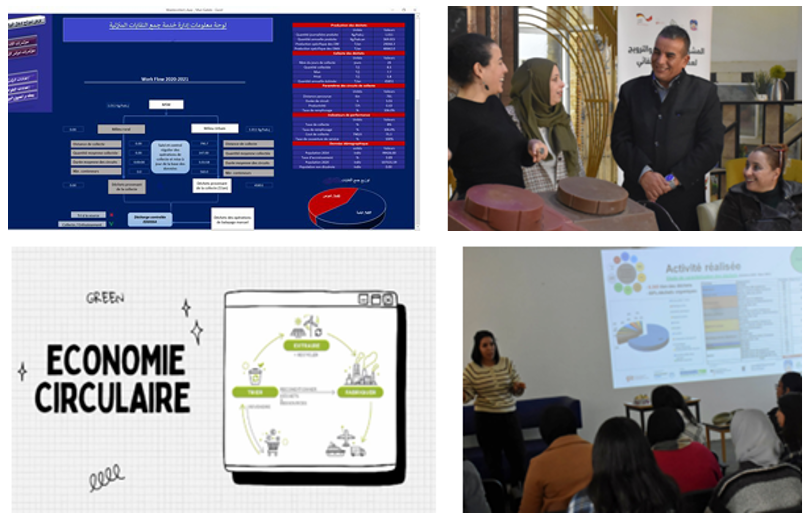
As part of the “City-to-City Cooperation Maghreb-Germany” regional Project (KWT II), the Tunisian municipalities of Jendouba and Kasserine implemented two complementary projects to optimize waste management. In partnership with the City of Wolfsburg, Jendouba developed a management dashboard for household and similar waste (HSW). Kasserine, in partnership with Munich, developed a vision and strategic guidelines for waste collection, management and recovery, building on the actions undertaken carried out in the KWT I project for the promotion of circular economy.
Tags: Cases | EVIMACC | Dashboard | Waste Management | Circular Economy | Household and Similar Waste (HSW) | Performance Indicators | Strategic Vision | Jendouba | Kasserine | Tunisia | Wolfsburg | Munich | KWT II | GIZ
Challenges addressed
- Limited awareness and mobilization of Jendouba’s municipal stakeholders at the beginning of the project
- Difficulties in collecting and structuring administrative data on waste management
- Limited local understanding of the circular economy, requiring extensive awareness-raising efforts
- Lack of structured performance indicators to assess the waste management system in Jendouba
- Need to coordinate several components (collection, transport and recovery) within a coherent strategic plan
- Lack of established channels for organic waste recovery and absence of structured recycling systems
Main objectives
- Improve monitoring and data collection and develop good practices in waste management in Jendouba
- Establish a dashboard with performance indicators to assess Jendouba’s household and similar waste (HSW) management system
- Support Kasserine in developing a strategic circular economy vision
- Identify areas for improvement and propose organizational solutions for waste management in Kasserine
- Guide both municipalities towards sustainable waste management based on the circular economy
Facts
Project type
Waste Management Dashboard (Jendouba) and Strategic Vision for a Circular Economy (Kasserine)
Partnership
Municipalities of Jendouba and Kasserine (Tunisia) | Cities of Wolfsburg (for Jendouba) and Munich (for Kasserine) (Germany) | Deutsche Gesellschaft für Internationale Zusammenarbeit (GIZ) – KWT II Regional Project |
Directorate General for External Relations and Decentralized International Cooperation, Ministry of Interior (Tunisia) | Engagement Global gGmbH / Service Agency Communities in One World (SKEW)
Funding
German Federal Ministry for Economic Cooperation and Development (BMZ) |
Total cost of the project: 13,060.00 TND (~3,870.00 €)
Start Date
Jendouba Dashboard: launched in 202 1
Kasserine Strategic Vision: launched in 2021 | KWT II: March 2020 – February 2024
Location
Municipalities of Jendouba (northwest) and Kasserine (central-west), inland Tunisia
Scaling Up
Follow-up regional project “Urban Adaptation to Climate Change in the Maghreb” (March 2024 – February 2027)
Project description
In Jendouba, the approach was structured around three phases: collection of administrative data, application of the quantitative waste characterization method, mapping of the spatial organization of waste collection and assessment of the baseline situation; analysis of the data, including the determination of performance indicators and identification of strengths and weaknesses; and finally, consolidation through the creation of a digital interface for monitoring the indicators (dashboard) and the development of strategic recommendations for the recovery of organic waste.
In Kasserine, the approach consisted of four stages: identification of the characteristics of the municipal sanitation department (staff, collection methods, illegal dumping sites and waste disposal); analysis of the physical composition of urban waste based on a characterization study conducted in 2021; development of strategic guidelines (waste sorting and selective collection system, composting unit, home composting, drop-off points, selective collection of coffee grounds, and a digital waste management plan); and development of a communication and awareness-raising strategy.
Around thirty virtual and in-person interactions took place between stakeholders from the Tunisian and German cities. Jendouba drew on the experience of Wolfsburg and Kasserine on that of Munich, particularly in waste management and the circular economy approach. Close, on-the-ground support provided by civil society organizations was a key factor in the success of both projects.
Impact and results
Results Achieved
- Four performance indicators determined in Jendouba: HSW collection rate (60%), coverage rate (75%), daily waste generation (1.5 kg/inhabitant/day), and average collection cost (TND 78/ton)
- Household waste composition analyzed in Jendouba: organic matter (63.2%), plastics (9.4%), textiles (8.7%), paper and cardboard (8.6%), metals (1.6%), and glass (1.1%)
- Strategic recommendations and guidelines developed for the recovery of organic waste in Jendouba (reorganization of collection routes, waste sorting at source, composting, and awareness campaigns)
- Strategic guidelines and a detailed action plan developed for a circular economy approach in Kasserine
- Two decision-support tools established: a dashboard (Jendouba) and a strategic vision (Kasserine) – the first initiatives of their kind in both cities
- Several virtual and in-person interactions organized between Tunisian stakeholders and their German partners
Lessons Learned
- Build on existing experience: Jendouba drew on the experience of Wolfsburg and Kasserine on that of Munich, through virtual and in-person exchanges on waste management and the circular economy
- Adopt a participatory approach: the success of both projects depended on the involvement of local stakeholders and the commitment of civil society organizations
- Adopt a change-management approach, supported by civil society organisations, to support local stakeholders in their waste recovery efforts;
- Strengthen municipal engagement from the outset: close, on-the-ground support is essential to mobilize stakeholders and ensure the implementation of the recommendations
Publications & main documents related to the case
MORE CONTENTS
Sorry, no posts matched your criteria.