Social cohesion ,economic development, youth, citizen engagement, youth plan

Local Youth Plan of Sant Vicenç dels Horts – Catalonia (2023-2026) -Pla Local de Joventut de Sant Vicenç del Horts 2023-2026-
The Mission of the Local Youth Plan of Sant Vicenç dels Horts 2023 – 2026 is to make available and offer resources, tools, instruments to young people so that they are responsible for and protagonists of their life project, throughout their life trajectory and through the interaction, individual and collective, with their social, political and economic context.
This mission, the result of social, institutional and political consensus, is composed of two main points:
• Facilitate the realization of the life project of young people by attending to the diversity of forms and models of life. That is, consolidate and make effective the basic rights of young people and guarantee the conditions that allow their quality of life and access to full citizenship, taking into account the specific difficulties inherent to the youth stage.
• Empower young people as agents of social change, promoting their active role as citizens in society as a whole, offering spaces for their participation in decision-making, as well as opportunities to give relevance to their vision of the world. Youth policies must promote the active and constructive role of young people beyond being recipients or users of policies to generate and build changes in our environment.
The Sant Vicenç dels Horts City Council conceives of young people as protagonists of their vital projects and at the same time as elementary agents of change and social cohesion of the present and the future. This plan considers comprehensive well-being as the fundamental pillar on which to build the two horizons previously expressed. Through the participatory diagnosis and the reflective work that a plan of these characteristics generates, the promotion of mental health has been established as one of the priority axes of action concerning well-being.
Not only because of the general worsening of the emotional well-being of young people due to the pandemic, but also because we consider the management of discomfort and prevention in terms of disorders, basic starting points to guarantee access to full citizenship for young people today and in their future as adults. Although this area is not a competence of municipal policies, there is a commitment and express will to improve the emotional well-being of young people, contributing to their comprehensive well-being, realization of the life project, and empowerment.
This municipal commitment is expressed in a clear orientation and allocation of resources to prevention policies, promotion of the community network, and attention and management of discomfort, not only in those programs expressly dedicated to the health field, but as a global mission of local youth policy.
Similarly, the search for the maximum reach of the municipality’s youth policies is also established as a priority, making them reach as many young people as possible and avoiding biases of gender, class, origin, etc. The present plan, therefore, has a universalist orientation, and despite not deploying actions in this regard, it presupposes all programs as lines of work aimed at the dissemination of services and resources and the effective engagement of young people in all their diversity. This objective arises from the public responsibility to distribute resources according to parameters of equity and social justice.
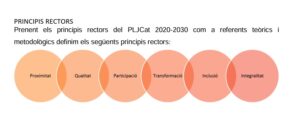 (GUIDING PRINCIPLES Taking the guiding principles of the PLJCat 2020-2030 as theoretical and methodological references, we define the following guiding principles: Proximity-> Quality -> Participation -> Transformation -> Inclusion -> Comprehensiveness)
Challenges addressed
To organize, structure and time all the actions that will be addressed by the public administration to the young people of the municipality during the coming years 202326, as well as quantify all the resources that will be necessary for their application. From this main objective, other specific ones are derived, to which it is also intended to respond:
• To have an in-depth analysis of the reality and needs of the young people of Sant Vicenç dels Horts.
• To establish the strategic lines of the youth policies aimed at the young people of the city
• To involve social agents in general, and young people in particular, in the analysis of the reality and in the design of the Local Youth Plan itself, as well as the result.
• To make use of the contacts and synergies generated to give continuity to the work coordinated with technicians, technicians, social agents and young people.
The youth policies of Sant Vicenç dels Horts cannot be disconnected from the National Youth Plan of Catalonia, in addition to action plans and strategic plans at national and regional levels. In this context, it is important to take into account the international framework of the 2030 agenda and the United Nations Sustainable Development Goals (SDGs), since the 17 SDGs and their 169 targets are becoming a universal declaration of development and allow global challenges to be faced locally, in collaboration with entities and institutions anywhere in the world.
More than a third of the 169 targets correspond to the field of youth, specifically or transversally, and according to the UN, the focus on youth is on three main axes: empowerment, participation and well-being. (UNDG, 2017). Specifically, the 20 goals focused on youth are:
• SDG#2 (zero hunger)
• SDG#4 (education)
• SDG#5 (gender equality)
• SDG#8 (decent work)
• SDG#10 (inequality)
• SDG#13 (climate action)
According to the UN, young people are especially key to promoting and achieving “participation, inclusion, accountability and revitalization of local and global governance”. This perspective understands the youth of our municipality as a great opportunity for change and adaptation.
Main objectives
As mentioned above, the main objective of the Local Youth Plan of Sant Vicenç dels Horts is to organize, structure and schedule all the actions that will be addressed by the public administration to the young people of the municipality during the coming years, as well as quantify all the resources that will be necessary for its implementation.
Based on this main objective, and taking into account the conclusions of the participatory diagnosis presented, as well as the available resources, it is essential to establish an initial general image of what the general objectives will be that will guide the overall action of the Plan. These objectives are linked and are also coherent with the challenges of the National Plan.
From these general objectives, the specific objectives are developed, which we find framed in the following points in the definition of the programs and actions.
Empower, guide and accompany the young person in their educational process in order to favor the realization of their life project.
• Inform and guide young people and their families in accessing services and resources designed to facilitate their educational paths.
• Spread the value of training among young people as a necessary element and facilitator of subsequent integration into the socio-labor world. • Offer spaces for support and accompaniment in studies to the youth of the municipality.
• Offer a space for advice and personalized attention to facilitate emancipation and the transition to adult life.
• Strengthen the formal educational process of young people at risk of exclusion.
• Initiate effective actions in programs and services against early school leaving.
• Match the non-formal educational offer with content appropriate to current labor needs and those of young people themselves.
• Initiate policies to strengthen and increase second-chance training centers
• Guarantee the existence of a wide range of training activities in different areas (environment, health, gender, equality, etc.)
• Offer training in leisure as an important tool to work on values and social skills.
• Work cross-functionally between the different departments of the administration and other agents involved in education.
• Incorporate training actions on road safety. Especially on VMPs Improve the employability of young people in order to increase their opportunities for access to work and the realization of their own professional project.
Establish support, coordination and transversality mechanisms necessary to increase the effectiveness of the actions of agents for the promotion of employment and the school-work transition.
• Offer the necessary tools to facilitate the orientation and employment insertion of young people.
• Inform, guide and train young people in accessing services and resources aimed at facilitating job placement, entrepreneurship and self-employment.
• Maintain a network between different professionals to inform, advise and accompany young people in the job search process.
• Promote first work experiences in the local administration and business network and create a stable communication network with local companies.
• Disseminate the value of occupational training and link young people to these to facilitate their insertion…
• Offer diverse and quality occupational training.
-Guarantee access to mobility for young people on equal terms, taking into account their specific needs.
-Strengthen advice and guidance on mobility and international mobility.
Improve the mobility of young people in Sant Vicenç on equal opportunities, reducing the risk of exclusion by neighborhood.
• Offer alternative modes of transport to the car.
• Increase the municipality’s daytime and nighttime connections with Barcelona and the rest of the region.
• Promote a sustainable city model.
• Increase the use of public transport among young people.
• Adapt the public transport service to the needs of young people.
- Initiate training and prevention actions in the use of VMP 31.
- Facilitate the home emancipation process by providing information for young people to access housing.
- Promote advice and support on emancipation matters for young people and establish a stable point of consultation.
- Facilitate the dissemination of actions carried out by the City Council and other administrations on housing and emancipation issues.
Facilitate the home emancipation process by increasing opportunities for young people to access.
• Promote alternative housing formulas in the municipality.
• Promote social/public housing at a fair price according to the territory and social housing exchanges and promotions for young people
• Establish youth empowerment mechanisms to avoid abusive practices towards young people within the municipal housing market.
Offer tools to young people to increase their emotional and social well-being by accompanying them in the experience of their youth condition
• Implement actions aimed at increasing healthy habits among the youth population.
• Promote the practice of sport as an improvement for people’s health.
• Promote emotional work and individual and community management of discomfort.
• Maintain and expand transversal work with municipal departments and other agents on health issues.
• Increase the acquisition of knowledge, habits and behaviors that contribute to the well-being of young people (physical and mental health, safe and sustainable mobility, affective and sexual, social, food and consumption, etc.), with languages, channels and agents close to them.
• Reduce risk behaviors among young people.
• Expand emotional care services (psychological care), and expand them with support actions (dynamics beyond psychological care)
• Guarantee young people’s access to specific information on healthy lifestyle habits and the risks involved in certain addictive behaviors or behaviours.
• Offer advice in those areas of health that cause doubts or problems for young people, with special attention to sexuality and affectivity.
Inform and maintain effective and efficient communication with young people through various channels
• Improve communication with and between young people.
• Provide rigorous and quality information through different media (websites, social networks, newsletters, posters, radio).
• Adapt the way of communicating to the changing youth reality.
• Create synergies between young people, entities and the youth service that promote information and participation.
• Ensure the correct use of social networks. • Optimize and expand the set of information areas with an increase in resources and with the implementation of a system of specialized services.
• Develop stable and diverse communication tools to disseminate information of all types and to give visibility to the Youth service as a whole.
• Facilitate access to information resources through decentralization and dynamization in secondary education centers and any other city facility that becomes a youth meeting space.
• Adapt and expand the information offer, to adapt to the needs of today’s youth, and become a reference service in this area.
Accompany young people in the processes of active integration into society
• Enable and encourage the participation of young people in all areas that affect them.
• Educate all young people in the municipality, especially in educational centers and those linked to youth organizations and groups, in values such as democracy and participation.
• Ensure the transversality and impact of young people’s participation in municipal action.
• Establish participatory operating methodologies that address the diversity of topics and interests of young people.
• Guarantee the presence of youth representation in the participation spaces promoted by the city council.
• Offer support to youth organizations and groups through training, advice, space assignments and support in the development of activities.
• Offer material to youth organizations to carry out talks and dynamics on emotions, sexuality, gender, etc.
• Bring the administration closer to young people.
• Improve networking between the different agents linked to social cohesion work.
• Define a motivating, useful and constructive participation model.
• Encourage the creation of networks and informal groups of young people to defend common interests and organize joint projects.
• Work to achieve positive and civic coexistence in public space.
• Generate intergenerational participation activities.
• Present diversity as an identifying element of the youth condition and enriching the cultural background of young people, individually and collectively.
• Prevent discriminatory behaviors or habits for reasons of gender, origin, culture, sexual orientation, ethnicity or functional diversity.
• Ensure gender equality among young people and overcome all discriminatory and sexist roles and behaviors.
• Prevent the risk of social exclusion of young people.
• Address situations of vulnerability and social exclusion.
• Raise awareness and involve young people in respect for the environment.
• Promote social integration and a sense of belonging to the territory of young newcomers.
Guarantee access to quality leisure and culture for all young people.
• Work on expanding and improving leisure and culture activities, giving priority to the demands of young people.
• Promote the practice of sports as an improvement for people’s health.
• Work to spread quality culture.
• Promote youth participation in different spaces in the field of culture, leisure and sports.
• Encourage work and spaces for young local creators in all artistic aspects.
• Offer alternative quality leisure spaces.
• Bring quality culture closer and educate through the performing arts.
• Guarantee the existence of a sufficient range of leisure activities to potentially serve the diversity of youth profiles existing in the municipality.
• Generate recreational meeting spaces for the city’s young people.
• Generate a stable offer of music that reflects the stylistic diversity of young people, as a recreational element that complements the city’s leisure offer, in addition to its strictly cultural values.
• Support the initiatives of young musicians at the local level
• Present a modern and quality musical training and dissemination offer.
• Present creativity as a value in itself.
• Encourage artistic productions by young people or creators.
• Propose self-promotion dynamics for young creators by providing dissemination and communication tools, while making their creative dynamics present to the city as a whole.
• Guarantee a plural and quality offer for children and young people.
• Support and promote the initiatives of entities dedicated to educational leisure.
• Coordinate joint actions of educational leisure entities in the city.
External resources
Facts
Project type Youth and Social Cohesion
Partners Sant Vicenç dels Horts City Council with the support of Iniciatives i Programes
Dates 2022-2026
Funding —
Project description
The Local Youth Plan (PLJ) of the Sant Vicenç dels Horts City Council is the instrument that will allow the design and implementation of comprehensive youth policies over the next few years (2023-26). The areas of action on which the YPP focuses are education and training, access to the labor market, mobility, housing and emancipation, health and affectivity, participation and social cohesion, and the promotion of culture, leisure and youth recreation.
Thus, the PLJ is based on a participatory diagnosis that analyzes the vision that young people themselves have of the policies that affect their daily lives. In this part, quantitative data is combined with the results of an online survey in which about 190 young people from Sant Vicenç dels Horts have participated and the contributions of a hundred young people collected in dynamics at the Vicentins institutes.
Evaluation
The Local Youth Plan must be a road map that guides municipal actions for this sector of the population, thanks to the coordinated and transversal work of all the agents involved. Likewise, the document is an ongoing mechanism, open to the incorporation of ideas, suggestions and proposals from the youth of Sant Vicenç.
The Local Youth Plan of Sant Vicenç dels Horts understands evaluation as an essential tool to obtain information about the results of the policies and the processes and agents that have been involved. Youth policies must incorporate from their design an evaluation approach that helps both to assess the impact that policies are having in relation to the proposed objectives and to take advantage of unplanned opportunities opened up by any public intervention process. In the same way, it is a fundamental exercise of transparency and accountability with the citizenship and the agents involved and, therefore, of democratic quality.
More about the evaluation and follow-up: read the full document from page 89
Publications & main documents
Climate shelters in the schools (video)
Sustainable courtyards in the schools (video)
Examples of climatic shelters and schools’ transformations (case by case, in Catalan):
- Patufet Pre-School
- Tramuntana School
- Martí Dot High School
- Monmany and Pau Vila Schools
- Fabregas Pre-School and Mestral School
- Mestral School
Future actions: Renaturalization of schoolyards (forseen for summer 2025)