
Éco-Cité Zenata (Morocco): Building a Sustainable City through Green Public Procurement
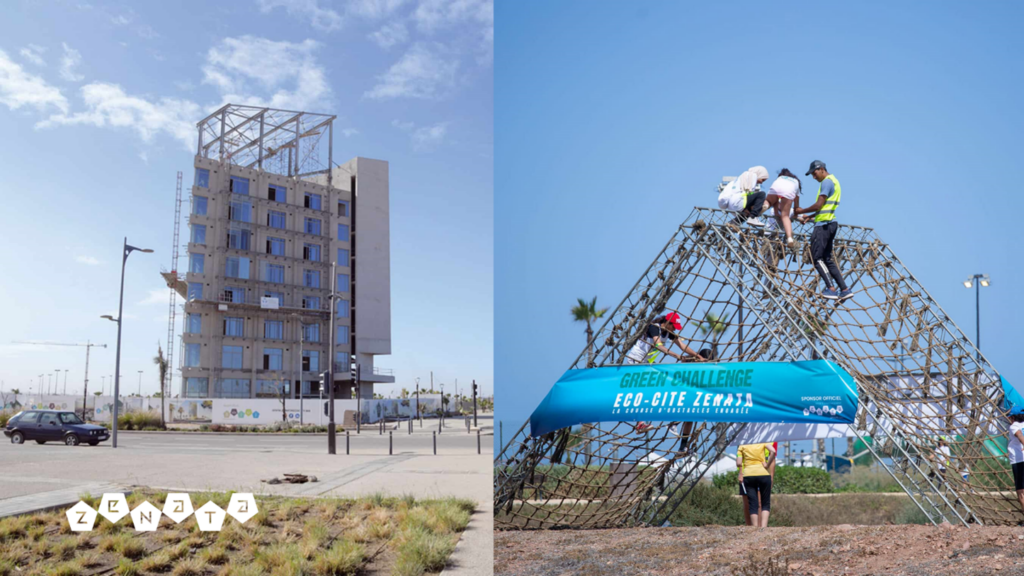
Éco-Cité Zenata is Morocco’s first planned eco-city and one of the most ambitious sustainable urban development projects in the Southern Mediterranean. Designed to respond to the rapid and often unplanned urban expansion of the Casablanca metropolitan area, Zenata adopts an integrated model of sustainable urban planning, combining bioclimatic design, green infrastructure, sustainable mobility, and social inclusion.
Beyond its urban design ambitions, Zenata stands out as a large-scale example of Green Public Procurement (GPP) in a non-European Mediterranean context. Led by a public development authority, all planning, construction, infrastructure, and public services are procured through public contracts embedding environmental criteria as structural requirements, demonstrating how procurement can act as a key driver of sustainable city-making.
Challenges addressed
- Uncontrolled urban sprawl and housing shortages in the Casablanca–Mohammedia corridor.
- High pressure on land, water, energy, and natural ecosystems.
- Need for new urban centralities capable of combining economic activity, housing, and quality of life.
- Social and spatial inequalities linked to informal settlements and limited access to services.
- Lack of large-scale precedents for environmentally driven public procurement in urban development projects.
Main objectives
- Develop a new sustainable city for up to 300,000 inhabitants, ensuring quality housing, services, and public space.
- Mainstream Green Public Procurement across all urban development contracts.
- Reduce environmental footprint through climate-responsive design, green infrastructure, and sustainable mobility.
- Create a new economic hub capable of generating up to 100,000 jobs.
- Enhance climate resilience and efficient resource management from the outset of urban development.
External resources
Facts
Project type :
Large-scale new city development (eco-city) implemented through public procurement and public–private collaboration
Partners:
- Société d’Aménagement de Zenata (SAZ), the public development agency in charge of the project, part of Morocco’s state-owned Caisse de Dépôt et de Gestion (CDG) Group.
- International urban planning and architecture firms (including Reichen & Robert and Franck Boutté Consultants).
- National public authorities responsible for housing, infrastructure, and environmental policies.
- Private developers and service providers engaged through public procurement and PPP schemes.
- Future partnerships with transport operators, educational institutions, healthcare providers, and commercial actors.
Funding :
- Predominantly public investment through CDG and SAZ.
- Public–private partnership mechanisms for selected real estate developments, facilities, and services.
Project description
Éco-Cité Zenata covers approximately 1,830 hectares in a strategic coastal location between Casablanca and Rabat. The project is structured around a set of core principles embedded directly into public procurement and planning frameworks.
- Bioclimatic urban design embedded in procurement
The city’s masterplan optimises street orientation and building layout to harness prevailing coastal winds, reduce heat stress, and minimise energy demand.
These environmental requirements are integrated into public tender specifications, making climate-responsive design mandatory for all contractors.
- Green infrastructure and nature-based solutions
More than 400 hectares of green spaces are reserved for parks, ecological corridors, and coastal landscapes.
Public contracts explicitly require the use of nature-based solutions, permeable surfaces, and ecosystem restoration techniques.
- Sustainable mobility and proximity-based urbanism
Zenata prioritises public transport, walking, and cycling, with over 44 km of pedestrian and cycling routes, complemented by compact, mixed-use neighbourhoods.
Mobility infrastructure is procured using environmental and social performance criteria consistent with GPP principles.
- Sustainable management of natural resources
The project integrates:
- sustainable urban drainage systems (SUDS)
- efficient irrigation and water reuse
- optimised utility networks to reduce losses.
All systems are delivered through public contracts incorporating environmental performance requirements.
- Economic development and social inclusion
Zenata combines residential areas with education, healthcare, commerce, logistics, and service hubs, aiming to generate up to 100,000 jobs.
Green Public Procurement is also used to promote local employment, responsible supply chains, and minimum social standards in construction and service provision.
Impact and results
Environmental impacts
- Reduced greenhouse gas emissions through compact urban form and sustainable mobility.
- Lower energy demand due to bioclimatic design strategies.
- Improved urban microclimate and reduced heat-island effects.
- Protection and restoration of coastal and peri-urban ecosystems.
- Enhanced long-term climate resilience.
Social and economic impacts
- Provision of a planned alternative to informal urban growth.
- Improved access to housing, services, and employment opportunities.
- Creation of a balanced, multifunctional urban centre supporting regional development.
- Strengthening of social cohesion through high-quality public spaces and facilities.
Green Public Procurement impacts
Éco-Cité Zenata demonstrates how public procurement can be a structural driver of sustainability, not merely a supporting tool:
- Environmental criteria are applied systematically across all contracts, from planning and infrastructure to buildings and services.
- Sustainability requirements are embedded at the design stage, influencing the entire life cycle of the city.
- The project represents a comprehensive GPP ecosystem, rather than isolated green purchases.
- Zenata provides a replicable model for Mediterranean cities seeking to leverage procurement as a catalyst for sustainable urban transformation.