Waste, City Strategies & Governance, environment and climate change


Pay As You Throw system in the municipality of Argentona (Catalonia)
Argentona is a town with around 12,000 inhabitants that introduced DtD waste collection in 2004 for the central urban area (around 8,000 inhabitants). In 2009, the DtD system was expanded for the lightweight packaging and paper and cardboard waste fractions to implement in 2010 a Pay As You Throw (PAYT) scheme. This system is accompanied with pre-paid standardized bags for residents and commercial activities and introduced a fair charge for waste called “Taxa Justa.” The DtD & PAYT systems were extended to all suburban areas of the municipality in 2016.
Challenges addressed
The control and sanctioning of the incorrect use of the system and other bad practices like illegal disposal or waste tourism were very important for the proper functioning of the DtD and PAYT schemes.
Main objectives
- Improvement of waste separate collection rate and its quality.
- Implementation of the polluter pays principle.
- Reduction of waste generation.
External resources
Inforgaphics about Pay as you Throw (in Catalan)
News in public local television, La Xarxa, 2010 (in Catalan)
Facts
Project type Introduction of PAYT system and related waste charge
Partners Municipality of Argentona (implementing authority)
Beneficiaries Argentona municipality / citizens
Dates 2009 – Ongoing
Fuding Own resources and grants received from the Waste Catalan Agency (ARC)
Project description
The PAYT system started with an initial residents’ participation process, followed by an information campaign during a pilot period of 3 months. The permanent staff and the information office followed the system operation and the users’ performance, which are key tools for the success of the model.
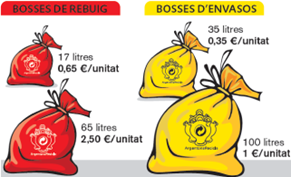
The PAYT scheme relies on the introduction of pre-paid standardized bags (with the town council’s logo) for residual waste (red) and lightweight packaging (yellow). Such bags were initially introduced for both businesses and households, but later, the yellow bags were eliminated for residents. The PAYT was also applied for the biowaste produced by businesses.
The household waste charge is divided into two parts: (1) a progressive part modulated depending on the number of residents per household and (2) a variable part as a function of the residual waste bags used. The municipality provided some bags included in the fixed part of the charge (10, 20 or 25 bags depending on the household’s members). Additional bags must be purchased at collaborating shops at a cost of 0.65€/17L bag.
Businesses pay a part of the charge calculated based on the surface of their premises and the type of activity they carry out and a variable part based on the number of standardized bags used for residual waste (2.5€/65L bag) and light packaging (1€/100L bag). Additionally, they pay separately for the biowaste bin depending on its volume.
Impact and results
- Between 2008 and 2019, the amount of waste generated daily per capita decreased by 26% to 1.27 kg/inhab/day. During the same period, the rate of separate waste collection increased from 52.8% to 87.6%. Residual waste dropped by 15% between 2009 and 2013 and packaging waste by 16%.
- The quality of the separately collected waste has remained high. The use of the municipal collection centers has increased. The system has been widely accepted by most of the population and was the subject of a broad political action.
- The monitoring activities to follow the system functioning and the users’ performance are key tools for its success. The introduction of the PAYT system requires i) an initial participation process, ii) an information campaign and iii) an initial test period to be successful. The pre-paid standardized bags are economical elements for the introduction of PAYT systems.
Publications & main documents
RELATED CONTENT
Sorry, no posts matched your criteria.


