CULTURE AND IDENTITY, MOBILITY, DATA ICT, TOURISM


Digital crowd management and visitor information in Dubrovnik’s Old Town


Dubrovnik is a UNESCO World Heritage city with approximately 40,000 residents, whose medieval core has become emblematic of overtourism as cruise arrivals and global media exposure have boosted visitor numbers far beyond local capacity. A 2015 UNESCO reactive monitoring mission warned that unmanaged crowding threatened the site’s outstanding universal value and called for stronger visitor management. In response, the municipality launched the “Respect the City” programme, combining operational tools and policy measures including real-time crowd monitoring so that managers can see density, communicate it to visitors and intervene before bottlenecks form.
Challenges addressed
Crowding in Dubrovnik’s Old Town is highly concentrated in both time and space, driven by cruise ship schedules, day visitors, and popular filming locations. Before digital tools were introduced, the city lacked a precise, real-time count of how many people were inside the walls, making it difficult to anticipate surges or to manage flows at main gates. Cruise arrivals, overnight stays, and weather conditions created highly variable patterns that could not be captured by simple averages.
At the same time, visitors and tour guides had little information about occupancy levels when planning their routes, and local concerns about overtourism and quality of life were growing. The Respect the City programme sought to address both operational blind spots and social tensions by linking measurement, communication and regulation.
Main objectives
The main objective of the digital components was to move from reactive to proactive crowd management in the Old Town. This meant counting people at the gates, publishing a live headcount and using predictive models to forecast surges so staffing and routing could be adjusted in advance.
A complementary objective was to improve the visitor experience and spread flows through time and space, by providing high-quality self-guided content via a dedicated audio-guide app and by aligning operations with policies such as limits on simultaneous cruise calls and, more recently, timed entry to key attractions. Together, these measures aim to protect the heritage site, safeguard residents’ quality of life and maintain Dubrovnik’s tourism economy on a more sustainable footing.
External resources
Facts
Project type Real-time crowd-monitoring and forecasting system for the Old Town (computer-vision people counting at gates, public occupancy dashboard, predictive model), combined with a digital audio-guide app offering offline maps and themed walking tours.
Partners The crowd-management system is led by the City of Dubrovnik as part of the “Respect the City” programme. Key partners include the Cruise Lines International Association (CLIA), which signed a memorandum of understanding with the city and funds the GSTC destination assessment, and the Dubrovnik Port Authority, which is committed to a long-term partnership under Respect the City. The Dubrovnik Tourist Board supports communication and promotion of the initiative, while research partners have designed and evaluated the people-counting and visitor-forecasting model used at the Old Town gates.
Funding Funding is drawn from municipal and tourism-related budgets under the Respect the City programme and associated crowd-management investments. Publicly available case descriptions emphasise the policy package and technical system rather than detailed cost breakdowns, but situate the project within broader efforts to manage tourism sustainably in a UNESCO site.
Project description
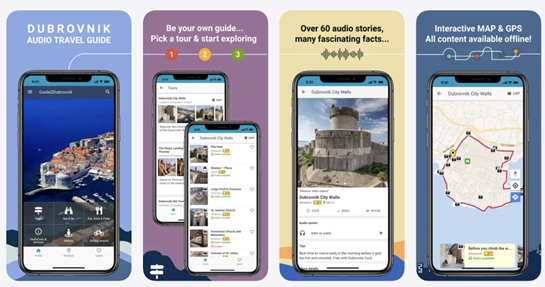
On the visitor-information side, Dubrovnik promotes Guide2Dubrovnik – Audio Guide, a self-guided app for iOS and Android that pairs an interactive map with more than two hours of professionally recorded commentary for the Old Town and City Walls. Once downloaded, all audio, maps and images are stored on the device for offline use, which is important given roaming costs and variable connectivity. The app offers several themed walking tours, including a Game of Thrones route, and short 1–2 minute stories that allow visitors to listen while walking, along with practical information such as ATMs, pharmacies and local tips. In 2019 the city activated a computer-vision counting system at the Old Town gates. Six people-counting cameras register entries and exits and generate a live headcount inside the walls, updated every 15 minutes.
This occupancy level is published on the Dubrovnik Visitors website with a simple traffic-light code: green for fewer than 6,000 people, yellow between 6,000 and 8,000, red above 8,000. A predictive model combines the live counts with scheduled cruise passengers, recorded arrivals and overnight stays, and weather forecasts to identify likely surges so that staff and route management can be positioned in advance. Operations are tightly aligned with policy.
Working with cruise lines, Dubrovnik set a practical cap of two ships in port at once, flattening peaks in daily visitor numbers. In September 2025, the mayor announced that from 2026 visits to the City Walls will require advance, timed reservations, while a special traffic-management zone around the historic core restricts vehicle access most of the year to protect the pedestrian environment.
These regulatory measures complement the digital tools by limiting maximum pressure, managing access to key assets and reducing motorised traffic near the core.
Impact and results
According to case materials, the combination of live counting, public dashboards and operational rules has shifted Dubrovnik from reactive to proactive crowd management. Managers, guides and visitors now share the same 15-minute occupancy status, which allows tour leaders to pace group entries during yellow periods and avoid short red peaks.
Comparisons between 2019 and earlier seasons show noticeably smoother flows through main gates when the system is used to spread entries and adjust routes. Publishing the occupancy levels online has also improved transparency and visitor self-management by allowing people to plan visits around the busiest windows.
More broadly, the integration of digital tools with cruise caps, future timed ticketing for the City Walls and a traffic-management zone demonstrates how heritage cities can pair technology with governance reforms to mitigate overtourism while maintaining a high-quality visitor experience.
Publications & main documents
RELATED CONTENT
Sorry, no posts matched your criteria.