• EN
LogoLogoLogoLogo Logo
 
  • Home
  • About
  • Cases
  • Voices
  • Tools
  • Contact
  • Home
  • About
  • Cases
  • Voices
  • Tools
  • Contact
  • Home
  • About
  • Cases
  • Voices
  • Tools
  • Contact
  • Environment & Climate Change
  • Waste
  • Energy
    • Rev’ACTE
  • City Strategies & Governance
  • Economic Development
  • Urban Planning
  • Mobility
    • UTC
  • Innovation
    • ProcuraMED
  • Culture & Identity
  • Social Rights

Malgrat de Mar’s bioclimatic network: building heat resilience and boosting urban biodiversity

Download full sheet
  • ENVIRONMENT & CLIMATE CHANGE |
  • WASTE |
  • ENERGY |
  • CITY STRATEGIES & GOVERNANCE |
  • ECONOMIC DEVELOPMENT |
  • URBAN PLANNING |
  • MOBILITY |
  • INNOVATION |
  • CULTURE & IDENTITY |
  • SOCIAL RIGHTS

ENVIRONMENT AND CLIMATE CHANGE


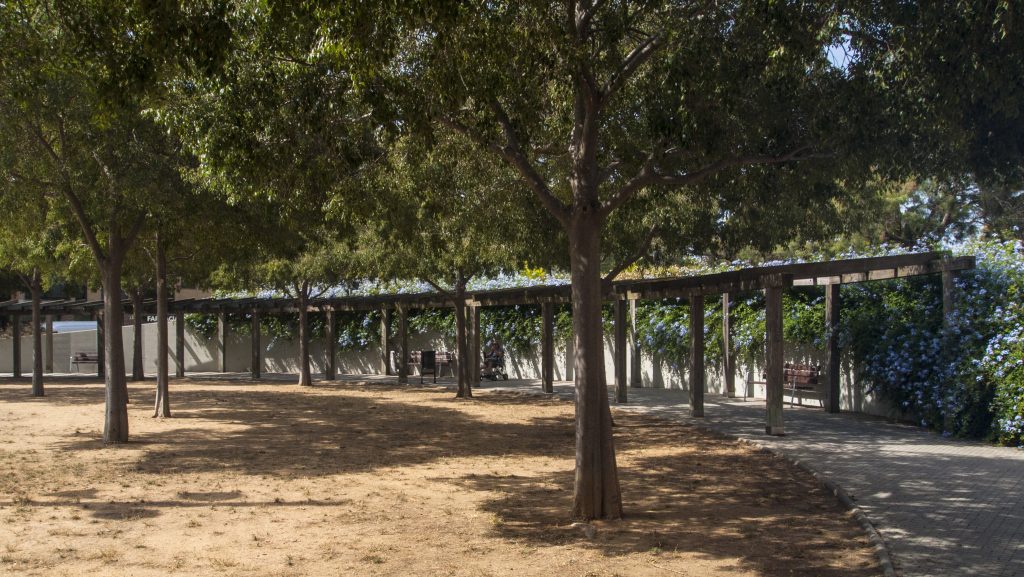
Malgrat de Mar’s heat adaptation strategy focuses on creating a network of bioclimatic shelters to enhance heat resilience and urban biodiversity. The city implements both outdoor shelters with high green surface coverage and indoor shelters that maintain comfortable temperatures.

Through a vulnerability analysis considering environmental, spatial, and socio-economic factors, the city identifies strategic locations for these shelters, aiming to protect vulnerable populations during heat waves and improve overall climate resilience.

Challenges addressed

• Urban Heat Island effect: The network of bioclimatic shelters helps reduce localized heat and provides cooler spaces for urban residents.
• Protection of vulnerable populations: heatwaves disproportionately impact at-risk groups, such as the elderly, children, and individuals with health conditions.
• Urban biodiversity loss: due to the urban development that reduces green spaces, negatively affecting biodiversity.

Main objectives

• Adapt the city to climate change, through the implementation of spaces that mitigate the effects of heat waves and torrential rains.
• Improve the quality of urban green spaces, increasing biodiversity and ecological connectivity within the municipality.
• Reduce the urban heat island effect, through designs that regulate temperature and provide thermal comfort to citizens.
• Promote an ecosystem vision, considering both humans and other organisms in the planning of bioclimatic shelters.

External resources

ACTION PLAN FOR SUSTAINABLE ENERGY AND CLIMATE OF THE MUNICIPALITY OF MALGRAT DE MAR (in Catalan)

Bioclimatic shelters in Malgrat de Mar news item (in Catalan)

Malgrat de Mar: a methodology to create a network of bioclimatic shelters (in Spanish)

Facts

Project type                             Climate shelter’s network project


Partners                                    Paisaje Transversal, Diputació de Barcelona


Beneficiaries                            Malgrat de Mar municipality


Dates                                          2024 – Ongoing


Website                                     Bioclimatic network project (in Spanish)

Project description

This project covers the idea of shelter in a scenario where not only the impact of temperatures on humans is resolved but also addresses this ecosystemic vision.

One of the first cases of its application and formulation has been established in Malgrat de Mar, a city that, in recent years, has made a strong effort through innovative interventions for adaptation to climate change, with naturalization and urban green projects, rain gardens or interventions to promote and care for the biodiversity of its territory, among others. There, Paisaje Transversal, and with the help of the Barcelona Provincial Council, we have had the opportunity to establish a study for the future creation of a network of bioclimatic shelters for the municipality.

Furthermore, it should be noted that the study does not stop at these but defines design criteria to improve the quality of urban green spaces and thermal regulation to combat the heat island effect, improve ecological connectivity and provide ecosystem value to the urban fabric. This work also serves to generate a conceptual and strategic framework to organize and prioritize interventions in the urban environment of the municipality.
Specifically, the project covers the following steps or objectives to follow to implement the shelter network:

1. Define a conceptual framework
2. Characterize bioclimatic shelters
3. Analyse urban vulnerabilities
4. Identify existing and potential bioclimatic shelters
5. Analyse accessibility to bioclimatic shelters
6. Establish a strategic vision at an environmental level for the municipality

Impact and results

• Reducing heat stress in urban areas: creating spaces that mitigate extreme heat, especially in vulnerable areas, and improving thermal comfort for the population, prioritizing the most sensitive groups (elderly people, children and groups with fewer resources).
• Increasing biodiversity and ecological connectivity: Promoting habitats for local flora and fauna and creating ecological corridors that connect existing natural spaces with urban areas, promoting the presence of native species.
• Adaptation to climate change: increasing urban resilience to high temperatures and extreme events, aligning with global environmental objectives and improving green infrastructure, such as the implementation of low-water consumption vegetation and draining pavements.
• Social cohesion and urban equity: creating accessible, inclusive and safe spaces for different social groups and reducing urban inequalities by prioritizing interventions in areas with greater socio-economic, environmental and spatial vulnerabilities.

Publications & main documents
RELATED CONTENT

Sorry, no posts matched your criteria.

Waste Management in Amioun (North Lebanon)
Cases, Environment & Climate Change, Waste,
NATURIncMed Methodological Guide: Participatory Urban Greening in Arab Cities
Environment & Climate Change, Tools, Urban Planning,
Digital-by-default payments and smart city infrastructure in Pafos
Cases, City Strategies & Governance, Data & ICT, Mobility, Small city, Tourist destinations,
Digital crowd management and visitor information in Dubrovnik’s Old Town
Cases, Culture & Identity, Data & ICT, Mobility, Small city, Tourist destinations,
Categories

CasesEnvironment & Climate Change

Tags
Bioclimatic shelters Environment and Climate Change green areas Green corridors greener cities Heat adaptation strategy Re-naturing Renaturation strategic plan sustainable urban areas Urban biodiversity Urban cooling Urban Heat Island
Share
  • Facebook
  • Twitter
  • Google+
  • LinkedIn

Legal mentions

contact@medcities.org


The Urban Transports' section is developed with the support of:

We value your privacy
We use cookies on our website to give you the most relevant experience by remembering your preferences and repeat visits. By clicking “Accept”, you consent to the use of ALL the cookies. However you may visit Cookie Settings to provide a controlled consent.
CustomizeReject AllAccept All
Manage consent

Privacy Overview

This website uses cookies to improve your experience while you navigate through the website. Out of these cookies, the cookies that are categorized as necessary are stored on your browser as they are essential for the working of basic functionalities of the website. We also use third-party cookies that help us analyze and understand how you use this website. These cookies will be stored in your browser only with your consent. You also have the option to opt-out of these cookies. But opting out of some of these cookies may have an effect on your browsing experience.
Necessary
Always Enabled
Necessary cookies are absolutely essential for the website to function properly. These cookies ensure basic functionalities and security features of the website, anonymously.
CookieDurationDescription
cookielawinfo-checkbox-analytics11 monthsThis cookie is set by GDPR Cookie Consent plugin. The cookie is used to store the user consent for the cookies in the category "Analytics".
cookielawinfo-checkbox-functional11 monthsThe cookie is set by GDPR cookie consent to record the user consent for the cookies in the category "Functional".
cookielawinfo-checkbox-necessary11 monthsThis cookie is set by GDPR Cookie Consent plugin. The cookies is used to store the user consent for the cookies in the category "Necessary".
cookielawinfo-checkbox-others11 monthsThis cookie is set by GDPR Cookie Consent plugin. The cookie is used to store the user consent for the cookies in the category "Other.
cookielawinfo-checkbox-performance11 monthsThis cookie is set by GDPR Cookie Consent plugin. The cookie is used to store the user consent for the cookies in the category "Performance".
viewed_cookie_policy11 monthsThe cookie is set by the GDPR Cookie Consent plugin and is used to store whether or not user has consented to the use of cookies. It does not store any personal data.
Functional
Functional cookies help to perform certain functionalities like sharing the content of the website on social media platforms, collect feedbacks, and other third-party features.
Performance
Performance cookies are used to understand and analyze the key performance indexes of the website which helps in delivering a better user experience for the visitors.
Analytics
Analytical cookies are used to understand how visitors interact with the website. These cookies help provide information on metrics the number of visitors, bounce rate, traffic source, etc.
Advertisement
Advertisement cookies are used to provide visitors with relevant ads and marketing campaigns. These cookies track visitors across websites and collect information to provide customized ads.
Others
Other uncategorized cookies are those that are being analyzed and have not been classified into a category as yet.
Reject All Save My Preferences Accept All
Powered by GDPR Cookie Compliance WebToffee Logo