• EN
LogoLogoLogoLogo Logo
 
  • Home
  • About
  • Cases
  • Voices
  • Tools
  • Contact
  • Home
  • About
  • Cases
  • Voices
  • Tools
  • Contact
  • Home
  • About
  • Cases
  • Voices
  • Tools
  • Contact
  • Environment & Climate Change
  • Waste
  • Energy
    • Rev’ACTE
  • City Strategies & Governance
  • Economic Development
  • Urban Planning
  • Mobility
    • UTC
  • Innovation
    • ProcuraMED
  • Culture & Identity
  • Social Rights

Rooftop farming in the Greater Cairo Region

Download full sheet
  • ENVIRONMENT & CLIMATE CHANGE |
  • WASTE |
  • ENERGY |
  • CITY STRATEGIES & GOVERNANCE |
  • ECONOMIC DEVELOPMENT |
  • URBAN PLANNING |
  • MOBILITY |
  • INNOVATION |
  • CULTURE & IDENTITY |
  • SOCIAL RIGHTS

ENVIRONMENT AND CLIMATE CHANGE


This pilot project, “Urban Agriculture in the Greater Cairo Region – The Example of Rooftop Farming in Informal Settlements”, aimed to reduce climate vulnerability in Cairo’s informal settlements through rooftop farming. Implemented in 2014, the project utilized hydroponic systems to grow various crops on rooftops, offering economic benefits and improving microclimatic conditions.

The initiative demonstrated positive impacts on food security, income generation, and community involvement, particularly among marginalized groups.

Challenges addressed

• Irregular water supply: limited and inconsistent access to water creates difficulties for sustaining agricultural activities.
• Heat stress that impacts crop productivity and the health of urban residents.

Main objectives

• Reduce climate vulnerability: in informal settlements through rooftop farming.
• Improve food security and income: for low-income communities in Cairo.
• Promote sustainable urban agriculture: as an adaptation strategy to climate change.

External resources

Urban Agriculture in the Greater Cairo Region (pdf presentation)

Renature Project article: Urban Rooftop Farming in the Greater Cairo Region

Panorama Solutions: A socio-economic approach to Urban Rooftop farming in the Greater Cairo Region
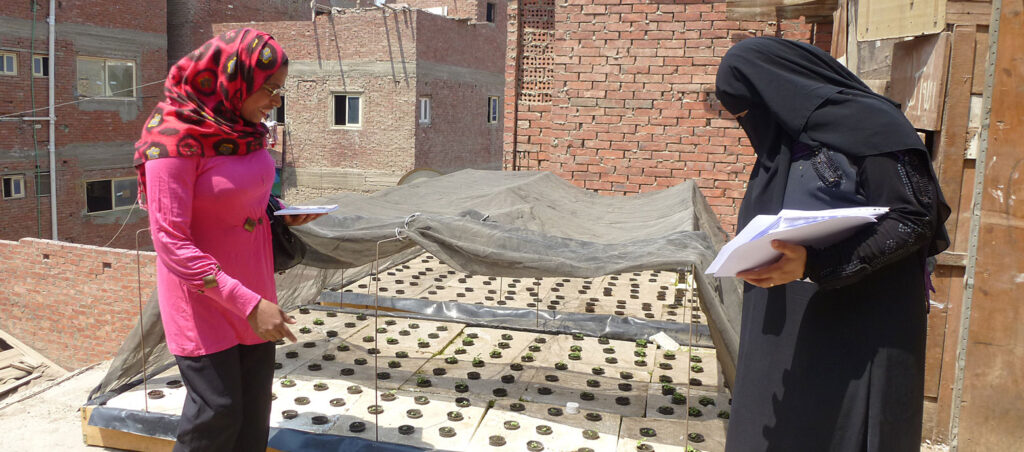
We Adapt: Urban Agriculture in the Greater Cairo Region. An Example of Rooftop Farming

Facts

Project type                            Rooftop farming pilot project


Partners                                  GIZ


Beneficiaries                          Greater Cairo Region


Dates                                        2014-2016


Website                                   Urban Rooftop Farming in the Greater Cairo Region

Project description

The “Urban Agriculture in the Greater Cairo Region – The Example of Rooftop Farming in Informal Settlements” project aimed to explore rooftop farming as an adaptation strategy to reduce climate vulnerability and improve living conditions in Cairo’s informal settlements. With the Arab region experiencing rapid urbanization and rising temperatures, traditional electricity-based cooling solutions like air conditioners have proven ineffective and overburden the grid. In contrast, rooftop farming provides an eco-friendly alternative, reducing heat stress, improving food security, and generating income.
In 2014, a pilot project was implemented in the Ezbet el-Nasr informal settlement. Using a hydroponic waterbed system, low-income families received training and technical support to grow various crops such as mint, tomatoes, and molokheya on their rooftops. To cover the costs of the system, participants took out repayable loans, which they repaid through the sale of their produce. The project also aimed to empower marginalized groups, such as women and youth, by promoting community participation and local economic development.

The key findings highlighted the importance of extensive capacity building, improved information on financial aspects, and addressing technical challenges like irregular water supply and electricity cuts. Additionally, the project’s success depends on the collaboration of NGOs, microfinance institutions, and social enterprises.

The lessons learned from this pilot suggest that rooftop farming has strong potential for climate adaptation, income generation, and community engagement in urban areas.

Impact and results

• Capacity building is crucial: The project emphasized the need for in-depth training, particularly through urban producer field schools. This approach helped participants gain hands-on knowledge and empowered them to manage rooftop farms effectively.
• Improved engagement through transparency: providing more detailed information on costs and operations allowed residents to better engage with the project, ultimately taking full responsibility for their involvement and contributing to its success.
• Technical innovation and adaptation: Various farming methods, including hydroponic and soil-based systems, were tested. The results revealed that further experimentation is needed to identify the most suitable system for local conditions, highlighting the importance of adapting to specific challenges.
• Overcoming challenges through financial support: Despite facing issues like irregular water supply and electricity cuts, the project demonstrated that income generation was a key motivator. The introduction of microcredits and micro-insurance could help ease financial barriers, ensuring the sustainability and scalability of rooftop farming initiatives.

Publications & main documents
RELATED CONTENT

Sorry, no posts matched your criteria.

Waste Management in Amioun (North Lebanon)
Cases, Environment & Climate Change, Waste,
NATURIncMed Methodological Guide: Participatory Urban Greening in Arab Cities
Environment & Climate Change, Tools, Urban Planning,
Digital-by-default payments and smart city infrastructure in Pafos
Cases, City Strategies & Governance, Data & ICT, Mobility, Small city, Tourist destinations,
Digital crowd management and visitor information in Dubrovnik’s Old Town
Cases, Culture & Identity, Data & ICT, Mobility, Small city, Tourist destinations,
Categories

CasesEnvironment & Climate Change

Tags
Community involvement. Environment and Climate Change Rooftop farming sustainable urban areas urban agriculture Vulnerable communities
Share
  • Facebook
  • Twitter
  • Google+
  • LinkedIn

Legal mentions

contact@medcities.org


The Urban Transports' section is developed with the support of:

We value your privacy
We use cookies on our website to give you the most relevant experience by remembering your preferences and repeat visits. By clicking “Accept”, you consent to the use of ALL the cookies. However you may visit Cookie Settings to provide a controlled consent.
CustomizeReject AllAccept All
Manage consent

Privacy Overview

This website uses cookies to improve your experience while you navigate through the website. Out of these cookies, the cookies that are categorized as necessary are stored on your browser as they are essential for the working of basic functionalities of the website. We also use third-party cookies that help us analyze and understand how you use this website. These cookies will be stored in your browser only with your consent. You also have the option to opt-out of these cookies. But opting out of some of these cookies may have an effect on your browsing experience.
Necessary
Always Enabled
Necessary cookies are absolutely essential for the website to function properly. These cookies ensure basic functionalities and security features of the website, anonymously.
CookieDurationDescription
cookielawinfo-checkbox-analytics11 monthsThis cookie is set by GDPR Cookie Consent plugin. The cookie is used to store the user consent for the cookies in the category "Analytics".
cookielawinfo-checkbox-functional11 monthsThe cookie is set by GDPR cookie consent to record the user consent for the cookies in the category "Functional".
cookielawinfo-checkbox-necessary11 monthsThis cookie is set by GDPR Cookie Consent plugin. The cookies is used to store the user consent for the cookies in the category "Necessary".
cookielawinfo-checkbox-others11 monthsThis cookie is set by GDPR Cookie Consent plugin. The cookie is used to store the user consent for the cookies in the category "Other.
cookielawinfo-checkbox-performance11 monthsThis cookie is set by GDPR Cookie Consent plugin. The cookie is used to store the user consent for the cookies in the category "Performance".
viewed_cookie_policy11 monthsThe cookie is set by the GDPR Cookie Consent plugin and is used to store whether or not user has consented to the use of cookies. It does not store any personal data.
Functional
Functional cookies help to perform certain functionalities like sharing the content of the website on social media platforms, collect feedbacks, and other third-party features.
Performance
Performance cookies are used to understand and analyze the key performance indexes of the website which helps in delivering a better user experience for the visitors.
Analytics
Analytical cookies are used to understand how visitors interact with the website. These cookies help provide information on metrics the number of visitors, bounce rate, traffic source, etc.
Advertisement
Advertisement cookies are used to provide visitors with relevant ads and marketing campaigns. These cookies track visitors across websites and collect information to provide customized ads.
Others
Other uncategorized cookies are those that are being analyzed and have not been classified into a category as yet.
Reject All Save My Preferences Accept All
Powered by GDPR Cookie Compliance WebToffee Logo