
• EN
LogoLogoLogoLogo Logo
 
  • Home
  • About
  • Cases
  • Voices
  • Tools
  • Contact
  • Home
  • About
  • Cases
  • Voices
  • Tools
  • Contact
  • Home
  • About
  • Cases
  • Voices
  • Tools
  • Contact
  • Environment & Climate Change
  • Waste
  • Energy
    • Rev’ACTE
  • City Strategies & Governance
  • Economic Development
  • Urban Planning
  • Mobility
    • UTC
  • Innovation
    • ProcuraMED
  • Culture & Identity
  • Social Rights

Bike lane network in Barcelona metropolitan area
Download full sheet
  • ENVIRONMENT & CLIMATE CHANGE |
  • WASTE |
  • ENERGY |
  • CITY STRATEGIES & GOVERNANCE |
  • ECONOMIC DEVELOPMENT |
  • URBAN PLANNING |
  • MOBILITY |
  • INNOVATION |
  • CULTURE & IDENTITY |
  • SOCIAL RIGHTS

MOBILITY

CasesLarge citySoft mobility & Low-carbontransportUtc

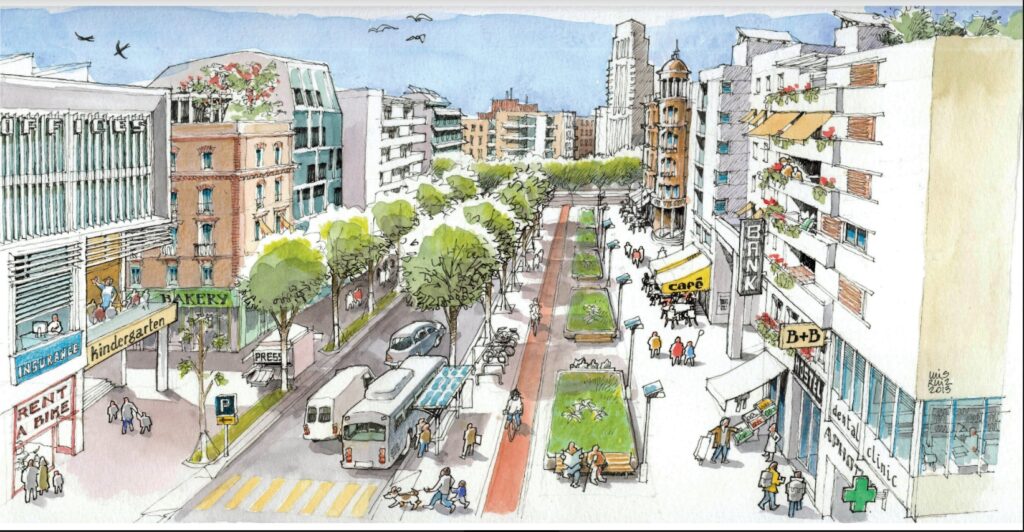
The BICIVIA is the metropolitan bike lane network that connects the metropolis and facilitates bike mobility fastly, directly and safely.

Challenges addressed

The municipal bike lanes are commonly shaped considering the municipal territorial limits, and fail to take into account the important social and economic flows linking municipalities among them. In the densely populated area of the Barcelona Metropolitan Area, this has resulted in low connectivity of bike lines across the 36 municipalities.

Main objectives

To interconnect the densely populated metropolitan area of Barcelona and its 36 municipalities by bike in a safe, affordable and fast way

External resources

https://www.amb.cat/en/web/mobilitat/projectes-oberts/detall/-/projecteobert/bicivia/6439486/11704

https://blogs.amb.cat/bicicleta/ca/2018/03/19/desplugues-a-barcelona-la-bicivia-7/

Facts

Project type                                                          Bike-sharing system


Promoter                                                               REMEDIO Project


Collaborators                                                        Split  Council


Start date                                                               2019


Funding                                                                 Interreg-MED


Website                                                                  Split bike sharing system

Project description

At the end of 2015 the municipalities were firstly consulted on the future shape of the metropolitan bike lane network. The 36 municipalities were divided into technical working groups to discuss and identify the best routes to connect each other. Different alternatives to shape the metropolitan map were analysed together with the municipal representatives of the 36 municipalities and the operators and owners (provincial council, Catalan government, and Spanish government). A first cycling network was presented and discussed with cycling stakeholders (NGOs) and in April 2016 the Metropolitan Council approved the network. 75 km of new bike lanes have been added to the plan as a response to the current global sanitary crisis, in an attempt to provide real and affordable alternatives to private-car.

Impact and results
  • 400 km of bike lanes across urban, economic and industrial areas
  • 36 municipalities connected by bike
  • An agreed plan by local, regional and national public bodies and bike-users associations
  • 366.246 bikes registered during 2019, with average of over 1.000 daily bikes

Publications & main documents
RELATED CONTENT
Istanbul Smart Mobility: Leveraging Public Procurement of Innovation to Manage Mobility in a Megacity
Cases, Innovation, Large city, Mobility, ProcuraMED, Public Procurement for Innovation, Shared mobility, Urban Planning
Digital-by-default payments and smart city infrastructure in Pafos
Cases, City Strategies & Governance, Data & ICT, Mobility, Small city, Tourist destinations
Digital crowd management and visitor information in Dubrovnik’s Old Town
Cases, Culture & Identity, Data & ICT, Mobility, Small city, Tourist destinations
Istanbul Smart Mobility: Leveraging Public Procurement of Innovation to Manage Mobility in a Megacity
Cases, Innovation, Large city, Mobility, ProcuraMED, Public Procurement for Innovation, Shared mobility, Urban Planning,
Digital-by-default payments and smart city infrastructure in Pafos
Cases, City Strategies & Governance, Data & ICT, Mobility, Small city, Tourist destinations,
Digital crowd management and visitor information in Dubrovnik’s Old Town
Cases, Culture & Identity, Data & ICT, Mobility, Small city, Tourist destinations,
Citywide GIS and digital heritage mapping in Alexandria
Cases, City Strategies & Governance, Culture & Identity, Data & ICT, Environment & Climate Change, Large city,
Urban
transports
Interreg Mediterranean
Categories

CasesLarge cityMobilitySoft mobility & Low-carbontransportUtc

Tags
Urban Urban Transports
Share
  • Facebook
  • Twitter
  • Google+
  • LinkedIn

Legal mentions

contact@medcities.org


The Urban Transports' section is developed with the support of:

We value your privacy
We use cookies on our website to give you the most relevant experience by remembering your preferences and repeat visits. By clicking “Accept”, you consent to the use of ALL the cookies. However you may visit Cookie Settings to provide a controlled consent.
CustomizeReject AllAccept All
Manage consent

Privacy Overview

This website uses cookies to improve your experience while you navigate through the website. Out of these cookies, the cookies that are categorized as necessary are stored on your browser as they are essential for the working of basic functionalities of the website. We also use third-party cookies that help us analyze and understand how you use this website. These cookies will be stored in your browser only with your consent. You also have the option to opt-out of these cookies. But opting out of some of these cookies may have an effect on your browsing experience.
Necessary
Always Enabled
Necessary cookies are absolutely essential for the website to function properly. These cookies ensure basic functionalities and security features of the website, anonymously.
CookieDurationDescription
cookielawinfo-checkbox-analytics11 monthsThis cookie is set by GDPR Cookie Consent plugin. The cookie is used to store the user consent for the cookies in the category "Analytics".
cookielawinfo-checkbox-functional11 monthsThe cookie is set by GDPR cookie consent to record the user consent for the cookies in the category "Functional".
cookielawinfo-checkbox-necessary11 monthsThis cookie is set by GDPR Cookie Consent plugin. The cookies is used to store the user consent for the cookies in the category "Necessary".
cookielawinfo-checkbox-others11 monthsThis cookie is set by GDPR Cookie Consent plugin. The cookie is used to store the user consent for the cookies in the category "Other.
cookielawinfo-checkbox-performance11 monthsThis cookie is set by GDPR Cookie Consent plugin. The cookie is used to store the user consent for the cookies in the category "Performance".
viewed_cookie_policy11 monthsThe cookie is set by the GDPR Cookie Consent plugin and is used to store whether or not user has consented to the use of cookies. It does not store any personal data.
Functional
Functional cookies help to perform certain functionalities like sharing the content of the website on social media platforms, collect feedbacks, and other third-party features.
Performance
Performance cookies are used to understand and analyze the key performance indexes of the website which helps in delivering a better user experience for the visitors.
Analytics
Analytical cookies are used to understand how visitors interact with the website. These cookies help provide information on metrics the number of visitors, bounce rate, traffic source, etc.
Advertisement
Advertisement cookies are used to provide visitors with relevant ads and marketing campaigns. These cookies track visitors across websites and collect information to provide customized ads.
Others
Other uncategorized cookies are those that are being analyzed and have not been classified into a category as yet.
Reject All Save My Preferences Accept All
Powered by GDPR Cookie Compliance WebToffee Logo