
Municipal waste management practices and governance models: Insights from the Mediterranean region
DESCRIPTION
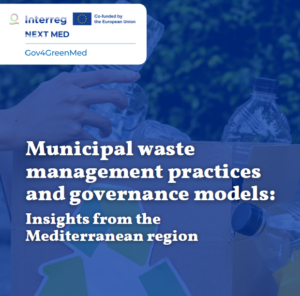
The catalogue from the Gov4GreenMed project ( funded by Interreg Next Med Programme) presents a comparative analysis of municipal waste management practices and governance
models across the Mediterranean region, developed within the framework of the Gov4GreenMed project.
The document aims to identify, assess, and systematise high-impact, replicable practices in solid and
organic waste management, with a specific focus on participatory governance, circular economy approaches, and local-level implementation models. The analysis covers experiences from Italy, Spain, Tunisia, Jordan, Türkiye, and additional Mediterranean contexts, examining both technical solutions and governance arrangements.
Using a structured and comparative methodology, the catalogue evaluates each practice in terms of:
operational and technical design, governance models and stakeholder engagement, participation mechanisms (including gender and youth dimensions), environmental, social, and economic impacts,
scalability, replicability, and implementation requirements.
Ultimately, this document provides an operational knowledge to support pilot actions and inform policy
design, facilitating the transfer and adaptation of tested practices across Mediterranean municipalities.
Tags: Waste management, Mediterranean countries, greener transition, inclusive governance models, participatory methodologies, municipal solid waste management
LINK TO THE TOOL
Good practices on waste management tool for Gov4GreenMed project
SOURCES
Gov4GreenMed on the Interreg Next Med website
Gov4GreenMed project on BETA Tech Center website (project leader)
Gov4GreenMed project on the MedCities website
YEAR
2026
CONTEXT
Gov4GreenMed: Inclusive Governance Models for a Greener Transition in the Mediterranean – designs territorial participatory methodologies on municipal solid waste management and food waste policies through five pilot actions in municipalities across Spain, Italy, Türkiye, Jordan and Tunisia. These initiatives aim to foster effective cooperation between local public authorities and various stakeholders and improve the development of local governance models. The final aim is to facilitate the implementation of shared public services, improve the quality of life of citizens, and support the green transition of Mediterranean municipalities.


