Cases, City Strategies & Governance, Urban Planning


Gender Atlas of Bologna: Mapping inequalities (2021)
Bologna is focusing on inclusive urban planning, specifically in public services and infrastructure.
The city wants to support the diverse needs of everyone. It wants to show how gender considerations are essential to sustainable environments.
Tags: Culture, urban planning, public services, infrastructures, development, social inclusion, gender inclusion, urban gender planning,
Challenges addressed
The city is taking several steps to ensure that public services and infrastructure address the needs of women and other underrepresented groups, such as the elderly, those of different abilities and the LGBTQI+ community. Areas where gender-sensitive approaches are being applied include lighting in public places, locations of pedestrian crossings, the design of bicycle networks, and the availability of childcare facilities near major employment areas.
Main objectives
To create a gender map of 180 pages and 80 maps to identify shortcomings, critical issues and opportunities that have to be addressed by the city, integrating a gender responsive planning perspective. This gender atlas helped Bologna to implement a climate action and urban regeneration plan, to modernise public buildings and make them more resilient to climate change and earthquakes. This work mainly focused on schools, kindergartens and administrative buildings and social housing; sustainable mobility and parks and other public open spaces.
Facts
| Project type | Documenting Gender inequalities in the city of Bologna through the production of a Gender Atlas |
| Partnership |
City of Bologna European Investment Bank Developed by Sex and the City |
| Funding | European Investment Bank: €50 million loan to help Bologna implement a climate action and urban regeneration plan |
| Start date | 2021 |
| Website | Bologna: pioneer in inclusive urban planning |
Project description
A gender map of 180 pages and almost 80 maps was created to allow the city to identify shortcomings, critical issues and opportunities, Bonzagni says. Funded by the European Investment Advisory Hub, the technical assistance helped analyse gender gaps and needs, building on experience from other European cities and existing data. The advisory support helped develop design guidelines for gender-inclusive projects in specific sectors (schools, bicycle networks, and open spaces), and proposed a new methodology and a “gender atlas” to design more inclusive urban infrastructure.
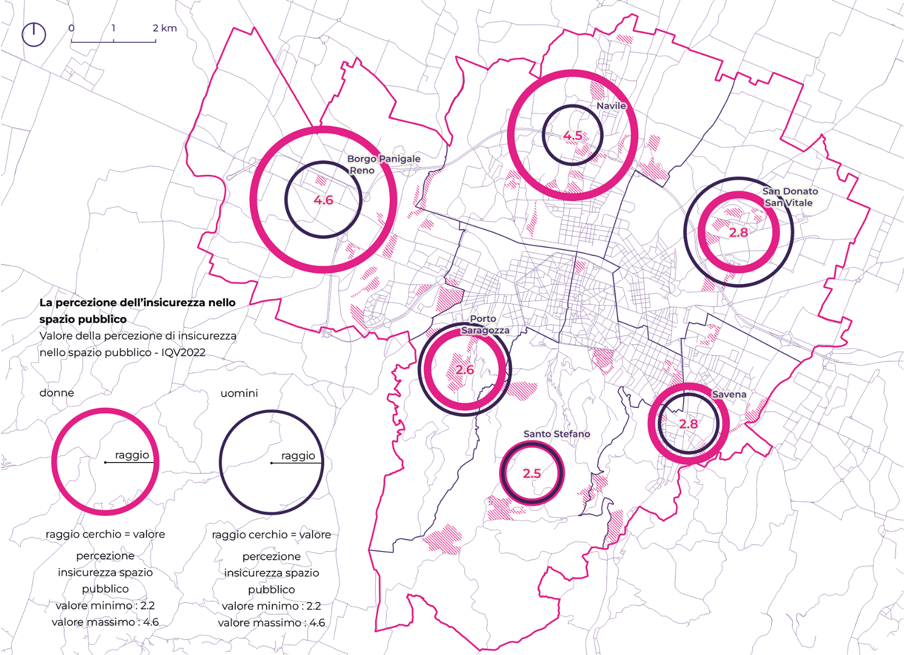
The gender atlas was prepared to help the city understand where it has problems with gender inclusivity. It is a tool that empowers citizens to understand the gender gap that coexists in their urban environment, allows technicians to develop new policies and allows EIB to evaluate its future investments within the city to guarantee an integrated gender vision. The Atlante provides a comprehensive view of the gender gap in Bologna. It illustrates various aspects of citizens’ well-being, needs, and overall quality of life. It delves into the characteristics of public spaces, examining the sense of security and the perceived quality that our residents experience. Additionally, it offers insights into how mobility functions within our urban landscape, and the infrastructures that underpin it. Of particular significance is the introduction of innovative statistical analyses, notably the Quality of Life Index with a fresh gender perspective, a pioneering effort by the city of Bologna.
Impact and results
The atlas is accompanied by a gender manual (tool).
While the atlas serves as a tool for mapping the city’s landscape, the manual is designed to assist in the planning and design of diverse urban spaces and facilities, ensuring a comprehensive consideration of gender perspectives.