MOBILITY AND INNOVATION


AI-supported management of metropolitan bus services in the Barcelona Metropolitan Area
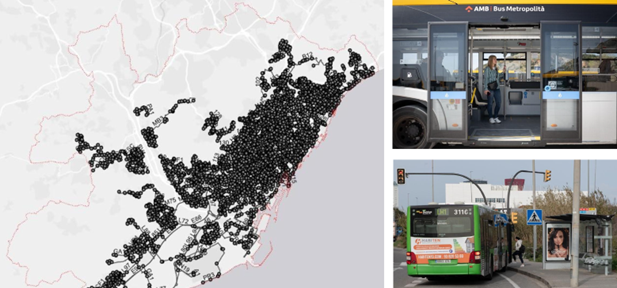


The Barcelona Metropolitan Area (AMB) is a second-level authority that coordinates mobility for 36 municipalities and about 3.4 million inhabitants over 636 km². Each day, residents make roughly 11.9 million trips, of which around 76.8% already use sustainable modes (public transport, walking and cycling). The system includes about 238 metropolitan bus lines, more than 5,200 bus stops, 8 metro lines, roughly 10,500 taxi licences and a 545 km Bicivia cycling network, with metro and bus services together carrying around 809 million passengers per year. Within this dense and complex context, AMB is progressively using data and artificial intelligence to manage the bus network. The AIDA / AI4BUS project was conceived as a practical tool for planners and dispatchers: it turns operational and contextual data into short- and medium-term demand forecasts and suggests how to adjust frequencies and fleet deployment. Rather than creating a stand-alone pilot, AMB uses this project as a testbed for its wider digital and AI agenda, linking day-to-day operations with an institutional effort to modernise mobility.
Challenges addressed
The project responds to several intertwined challenges.
First, it is difficult to anticipate highly variable bus demand, influenced by tourism, events and changing travel habits, with planning tools that largely relied on historical averages and expert intuition.
Second, AMB must coordinate service levels across a heterogeneous metropolitan network, where lines and municipalities have very different profiles but depend on shared resources.
Third, the data already produced by ticketing, operations, and external sources was underused and fragmented, which limited its value for decision making. Finally, there was an organisational challenge: integrating new analytical approaches into existing workflows without overburdening staff or widening the gap between large, data-savvy units and smaller teams with fewer digital skills.
Main objectives
The primary objective is to transform existing operational and contextual data into a practical decision-support tool that enables AMB to plan and operate bus services more effectively. More specifically, the project aims to stabilise service quality for users, reduce unnecessary vehicle kilometres, and free up capacity that can be redirected to critical sections or underserved time slots.
External resources
Facts
Project type Development and deployment of an AI-based decision-support system for bus planning and operations, combining forecasting and optimisation: first as AIDA on the Aerobús airport connector and then as AI4BUS extended to regular metropolitan bus lines.
Partners The initiative is led by AMB through its Mobility, Transport and Sustainability Department and its digital services. The AIDA pilot was promoted by the Government of Catalonia, via the Secretariat for Digital Policies and the CIDAI, with AMB as challenge owner and the technology centre Eurecat as developer. Building on this, AI4BUS is implemented by a consortium formed by Eurecat and the public company AMB Informació i Serveis, S.A., which operates AMB’s information and mobility apps; Eurecat’s Big Data & Data Science Unit is in charge of predictive models, frequency optimisation and the demonstrator
Funding The funding comes from a combination of metropolitan resources and national R&D&I programmes. AIDA is an impact project of CIDAI under the Catalan Artificial Intelligence Strategy, supported by the Government of Catalonia together with AMB and Eurecat. AI4BUS is financed by Spain’s Ministry of Science, Innovation and Universities through the public-private collaboration call of the State Plan for Scientific, Technical and Innovation Research 2021–2023, with Eurecat and AMB Informació i Serveis as consortium partners
Project description
This project covers the idea of shelter in a scenario where not only the impact of temperatures on humans is resolved but also addresses this ecosystemic vision.
The AIDA / AI4BUS initiative was designed to make better use of the data that AMB already collects in the course of running its bus services. AIDA, developed as a CIDAI impact project, focused on the Aerobús airport corridor, a high-frequency link of 2 lines, approximately 33 km in total, with a dedicated fleet of 33 fully accessible vehicles carrying around 5.7 million passengers per year.
On this corridor, demand is closely linked to flight activity and any mismatch between capacity and flows is immediately visible. Historical series on boardings, vehicle occupation, queues and timetables were combined with information on air traffic, events, holidays, metro operations and weather to build a model that predicts demand in the short and medium term and estimates the fleet required to cover it while respecting existing headways. Building on this proof of concept, AI4BUS scales the approach to regular metropolitan bus lines across the 36 municipalities. The project integrates heterogeneous data sources to capture the complexity of the bus network and adds an explainability module that shows the contribution of internal and external variables to the predictions, making the system more interpretable for planners and dispatchers.
Once the first implementations proved useful, the methodology began to be applied progressively to other parts of the metropolitan network, with particular attention paid to interfaces that are understandable for non-data specialists. This case is one of the pilots inspiring the broader digital strategy developed under the Vice-Presidency for the Digital Metropolis.
Impact and results
Early results on the Aerobús corridor show that the tool helps teams anticipate peaks linked to specific flights or events and plan reinforcement services before problems arise, rather than reacting ex post. The progressive roll-out is already improving conversations between planners and operators, because decisions on frequencies and deployment can be discussed on the basis of shared projections and visualisations instead of relying only on intuition and simple averages.
The project is also contributing to a more systematic use of data inside AMB by clarifying which datasets are needed, how they should be maintained and how they can be reused in other applications. In addition, involving staff in the design and testing phases has helped demystify AI, which is now perceived less as an external “black box” and more as an incremental extension of existing analytical practices.
Over time, these institutional effects are expected to be as important as the direct operational gains in terms of kilometres saved, more stable headways and improved passenger comfort in a metropolitan system that moves hundreds of millions of people every year.