CITY STRATEGIES AND GOVERNANCE, ENVIRONMENT AND CLIMATE CHANGE, CULTURE AND IDENTITY


Citywide GIS and digital heritage mapping in Alexandria
Alexandria is a fast-growing coastal metropolis whose planners must guide urban expansion while safeguarding dense layers of cultural heritage and a vulnerable shoreline. For many years, information on roads, utilities, public buildings, land use and protected areas was scattered across paper plans and stand-alone files, which made it difficult to coordinate works or assess impacts on heritage. As part of the Strategic Urban Plan (SUP) to 2032, the city and its partners decided to build a shared geographic information system (GIS) that could serve as an authoritative spatial reference for permits, investments and risk management, and to complement it with detailed digital mapping of key heritage areas such as the Qaitbay precinct.
Challenges addressed
Before the SUP process, Alexandria’s planning departments worked with fragmented, outdated or non-georeferenced information, which limited both cross-department coordination and transparency. Critical decisions on land use, utilities and infrastructure were made without a single, agreed basemap, and heritage constraints were often consulted separately from works planning.
At the same time, coastal heritage sites such as Qaitbay face pressure from development, subsidence and sea-level rise, yet existing documentation was largely two-dimensional and not easily integrated into day-to-day planning tools. Building a citywide GIS and digital heritage layers was therefore essential both to modernise routine planning and to improve conservation and risk assessment in highly sensitive zones.
Main objectives
The main objective was to consolidate core spatial datasets—road centre lines, land use, administrative boundaries, public facilities, protected areas—into a single GIS that could support the Strategic Urban Plan to 2032 and become the default reference for municipal decisions.
A second objective was to treat cultural heritage as an operational layer rather than an afterthought, by building dedicated geodatabases, interactive maps and 3D models for key sites and cultural routes. The SUP process also aimed to strengthen planning capacity by training local and regional teams in GIS use so that evidence-based analysis would become routine in permit issuance, infrastructure planning and heritage management.
External resources
Facts
Project type Participatory strategic urban plan with a citywide GIS backbone, combined with thematic heritage GIS: geodatabases of cultural assets, interactive route maps and 3D / photogrammetric documentation of emblematic sites such as Qaitbay and the Pharos lighthouse zone.
Partners The GIS and SUP were prepared under a United Nations Development Programme (UNDP) project in cooperation with the Governorate of Alexandria and national planning bodies. The Bibliotheca Alexandrina’s Alexandria and Mediterranean Research Center (Alex Med) played a key role in assembling multi-sector datasets and publishing maps and reports. Academic partners, including teams behind recent heritage GIS and 3D work, contributed specialised geodatabases and public web maps that complement the municipal system.
Funding The strategic plan and citywide GIS were financed through the UNDP “Participatory strategic urban planning for Alexandria City till 2032” project together with national and local contributions. Heritage-focused GIS and 3D documentation, such as the Qaitbay work and associated StoryMap, were supported by research funding and cultural-heritage programmes linked to the Bibliotheca Alexandrina and partner institutions.
Project description
Under the SUP 2032 project, Alexandria assembled dispersed spatial information into a unified GIS. Core layers such as roads, land use, administrative boundaries and key public facilities were digitised or updated and stored in a single environment so that departments could work from a common basemap. The Bibliotheca Alexandrina’s Alex Med centre helped integrate multi-sector datasets and disseminate them through maps and reports for planners and stakeholders.
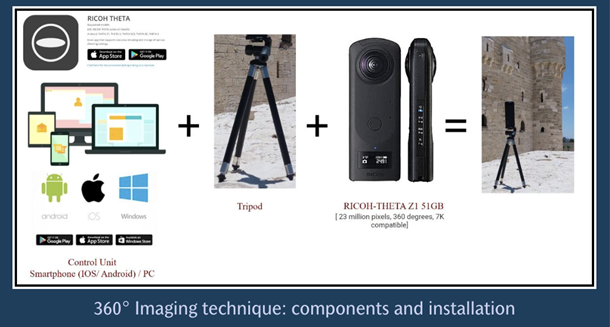
In parallel, academic teams built a detailed geodatabase of heritage assets and produced interactive web maps and route analytics, allowing users to visualise clusters of monuments, assess accessibility and design cultural itineraries. At the site scale, recent projects have documented the Qaitbay citadel and its underwater surroundings using photogrammetry and image-based 3D modelling, published via an ArcGIS StoryMap and related outputs. These models, combined with remote-sensing studies of crustal deformation and sea-level trends, provide a rich spatial evidence base for conservation, risk assessment and potential virtual-tour experiences.
Impact and results
The new land-use plan updated administrative boundaries and associated GIS are now used by the local authority when issuing permits and anticipating development, and the GIS is expected to sit at the core of management and decision-making processes. For heritage and tourism, the combination of citywide cultural-route mapping and site-specific 3D work has given planners and heritage managers spatial tools to weigh interventions before works proceed and to design visitor flows that respect constraints.
The Qaitbay digital models and underwater surveys illustrate how GIS-linked 3D documentation can inform maintenance, interpretation and resilience planning for one of Alexandria’s most sensitive precincts, while also offering material for public-facing storytelling. More broadly, the case shows that investing in a shared basemap, integrating heritage in the same environment as infrastructure, and pairing software with training and governance can shift a city from fragmented, paper-based planning toward GIS-supported decisions that balance growth, heritage and climate risk.
Publications & main documents
RELATED CONTENT
Sorry, no posts matched your criteria.