MOBILITY


Integrated traffic management and public transport priority in Casablanca


Casablanca, Morocco’s largest city and economic hub, experienced chronic congestion and fragmented operations across traffic signals, tram, buses and traveller information. Tram expansion and, more recently, the CasaBusway bus rapid transit (BRT) strengthened mass transit, but city leaders concluded that adding road capacity alone was unsustainable.
They therefore launched a metropolitan-scale smart mobility programme built around an intelligent traffic management system and a cross-cutting urban platform to monitor flows in real time, coordinate intersections adaptively, prioritise public transport, respond quickly to incidents and inform travellers, while feeding analytics back into planning
Challenges addressed
The city faced persistent peak-period congestion on major corridors, limited scope for new road construction and fragmented management between different modes and operators. Signals were largely on fixed-time plans with only partial coordination, which restricted the ability to react to incidents or to give priority to trams and BRT at intersections.
Information for travellers was scattered across channels, increasing uncertainty and discouraging public transport use. At the same time, planners lacked a unified, data-rich view of network performance to guide investments and operational changes. The smart mobility programme was designed to tackle these issues simultaneously by integrating control, data and information flows at metropolitan scale.
Main objectives
The main objective is to move from fragmented, fixed-time control toward an integrated, traffic-responsive system that optimises circulation on key corridors while favouring mass transit. Concretely, Casablanca aims to monitor traffic and public transport in real time from a central command and control centre; adapt signal timings at hundreds of intersections; extend video protection and incident detection; provide reliable, multimodal information through official digital channels; and use the resulting data to evaluate performance and support planning.
A further objective is to build local operational capacity so that the platform and tools can be sustained and extended to other urban domains over time.
External resources
Facts
Project type Integrated urban traffic management and mobility platform: central supervision centre, adaptive control of around 200 signalised intersections, video-surveillance at roughly 500 sites, variable message signs, Bluetooth travel-time sensing and an official multimodal information app for tram and BRT.
Partners The system was delivered through a metropolitan programme involving the City of Casablanca, national authorities and technology integrators. Project documentation and integrator materials (e.g. Minsait) describe an urban platform acting as an “integrating brain” that consolidates data from signals, cameras and public transport. Operation of the tram and CasaBusway BRT is entrusted to RATP Dev, whose network management and customer information are tied into the overall mobility system.
Funding Financing combines local and national public investment in smart-city and mobility infrastructure, as reflected in the smart-city contract with the integrator for the urban platform and traffic management system, and in the separate investment packages for tram and BRT lines. These investments are framed as part of Casablanca’s broader urban modernisation programme.
Project description
Casablanca’s smart mobility programme established a central command and control capability anchored by an urban platform and upgraded, centrally controlled traffic signals. Around 200 signalised intersections are equipped for dynamic control, allowing cycle lengths, green splits and offsets to be adjusted in response to observed flows. In parallel, video protection has been progressively generalised to about 500 sites, and variable message signs complement cameras and Bluetooth travel-time sensors to provide a rich, real-time picture of conditions on major arteries.
Operations are monitored from a police-led command centre equipped with a large video wall, where operators can detect incidents and act remotely on signals and corridor management. The system is tightly linked to mass transit. Tram lines are designed to receive signal priority at intersections, and the CasaBusway BRT corridors are operated with integrated control to maintain regular headways and reliable journey times.
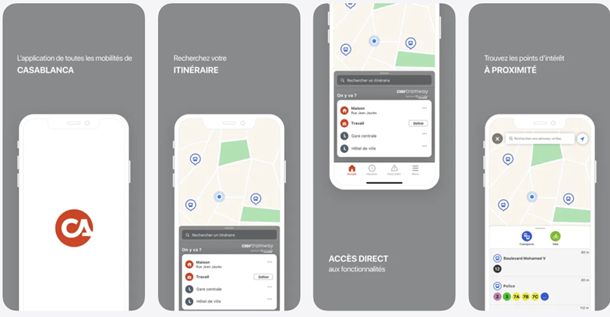
In 2024, two new tram lines (T3 and T4) entered service alongside the CasaBusway BRT, expanding the reach of high-capacity public transport. Traveller information is consolidated in the official Casatramway & Casabusway mobile app, which provides real-time departures, disruption alerts, route planning and saved favourites across tram and BRT, so that passengers have a single reference point for network status.
Impact and results
The integrated traffic management system has shifted Casablanca away from fixed plans and fragmented control toward a coordinated, data-driven approach. At treated intersections, dynamic signal control and central supervision are expected to reduce delays and improve travel-time reliability, while the combination of camera coverage and Bluetooth sensing strengthens incident detection and clearance on busy corridors. For public transport, signal priority and coordinated corridor management support the reliability of tram and BRT services, making them more attractive alternatives to private cars.
The central platform’s “integrating brain” role also facilitates phased extension: new modules, such as additional lines or enforcement tools, can be plugged into the same architecture without redesigning the system, and analytics from operations can be fed back into planning. Public communication around surveillance and enforcement features has helped secure acceptance, and the successful launch of CasaBusway alongside new tram lines illustrates how combining technology, infrastructure and policy measures can deliver visible improvements in metropolitan mobility.
Publications & main documents
RELATED CONTENT
Sorry, no posts matched your criteria.