MOBILITY


Digital-by-default municipal e-services in Athens
During the post-crisis recovery and under pressure from COVID-19, the City of Athens decided to overhaul how residents and businesses interact with municipal services. Previously, many procedures required a visit to city hall for certificates, permits, payments or repair requests, creating queues, paperwork and delays.
The municipality’s response was to design a one-stop digital gateway that could host high-demand municipal procedures, connect to national identity and delivery channels, and offer secure, remote completion of tasks while keeping assisted options for those who need support. Launched in 2020 and expanded rapidly, the Athens e-services platform now provides digital access to virtually all municipal services and has become a reference model for other Greek municipalities.
Challenges addressed
Athens faced a familiar mix of challenges in local service delivery. Residents and firms depended on in-person visits for basic interactions, which was costly in time and administrative effort and became untenable during pandemic restrictions. Back-office systems were fragmented, making it difficult to integrate processes and track cases end-to-end.
At national level, Greece was investing in digital identity and central platforms, but municipalities needed a way to connect to these assets and redesign their own procedures around them.
The municipality also wanted to strengthen participation and communication with citizens without creating separate, uncoordinated apps.
Main objectives
The main objective was to create a secure, user-friendly one-stop portal through which residents and businesses could access the full spectrum of municipal services online, using existing national credentials. More specifically, Athens sought to prioritise high-demand services to deliver quick wins, rationalise and integrate back-office workflows behind a single front door, and provide clear digital notifications throughout the process.
A further objective was to design the platform so it could be reused by other municipalities, turning Athens’ investment into a shared asset at national level, and to connect administrative services with engagement tools and targeted support initiatives such as the Energy Poverty Alleviation Office and the Adopt-a-Tree programme.
External resources
Facts
Project type Development and operation of a municipal one-stop e-services portal with secure authentication, digital delivery of certificates and permits, online appointment scheduling and integrated engagement features, complemented by thematic services such as energy-poverty support and a tree-adoption app.
Partners The platform is led by the Municipality of Athens and is profiled in the European Institute of Public Administration’s EPSA case library as a digital-government best practice. It is tightly integrated with national systems: users authenticate with Greece’s Taxisnet credentials, and completed documents are delivered to citizens’ digital inboxes in line with national arrangements. The city has also partnered with external providers, such as Novoville for the Adopt-a-Tree module.
Funding The e-services platform has been financed primarily through municipal budgets aligned with Greece’s wider digital-government agenda, making use of national frameworks for identity and digital document delivery. Additional related initiatives, such as the Energy Poverty Alleviation Office built on the EU-funded POWERPOOR project, draw on European and climate-energy funding streams while using the same one-stop logic for service access.
Project description
Athens launched its e-services gateway in 2020 as a single point of access for municipal procedures. The portal, available at eservices.cityofathens.gr, allows users to log in with their national Taxisnet credentials, which ensures secure identification without creating a separate local account system.
Once authenticated, residents and businesses can request certificates, submit applications, book appointments and, in many cases, receive the resulting document in their official digital inbox, with email and SMS notifications when processing is complete. The city expanded the catalogue quickly: by January 2023 Athens announced that all municipal services were available online, counting 207 distinct services accessible through the portal, effectively making digital access the default channel for municipal interactions.
The same ecosystem supports engagement and thematic services. The platform includes modules for controlled parking management, appointments and specialised services such as pet adoption, and is designed so that other municipalities can adopt the solution; after a public call, more than 90 municipalities decided to take up the platform and around 30 use it extensively, extending Athens’ model across the country. In parallel, the municipality has set up an Energy Poverty Alleviation Office as a one-stop service for vulnerable households, building on the EU-funded POWERPOOR project and mapped in the Covenant of Mayors library.
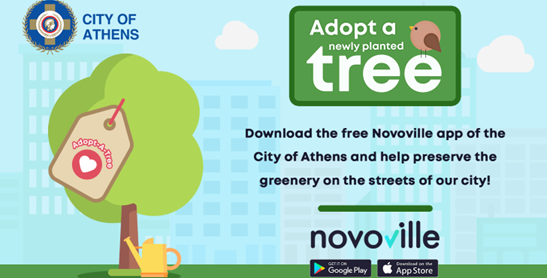
A lighter, participatory layer is provided by the Adopt-a-Tree module, run via the Novoville app and web interface, where residents can select a street tree on a map, “adopt” it and log watering events; data from these actions feed back into municipal monitoring of urban greenery.
Impact and results
Evidence from the city and from the EPSA case library points to strong uptake and tangible benefits. Since launch, more than 34,000 appointments have been scheduled through the platform, administrative transactions have shifted from counters to online channels, and thematic services such as animal adoption and controlled parking have been integrated into the same digital environment.
The functional reuse of the platform by dozens of other municipalities shows that Athens has moved beyond a single-city pilot to a de facto standard for local e-government in Greece. From a governance perspective, the project demonstrates how prioritising high-demand services, aligning with national identity and delivery infrastructures, and maintaining assisted in-person options on the same backend can accelerate digital transition while preserving inclusion.
The Energy Poverty Alleviation Office and Adopt-a-Tree initiative further illustrate how the one-stop logic can be extended to social and environmental domains, linking administrative efficiency with targeted support and citizen participation.
Publications & main documents
RELATED CONTENT
Sorry, no posts matched your criteria.