WASTE MANAGEMENT


Smart and data-driven waste management in Métropole Nice Côte d’Azur
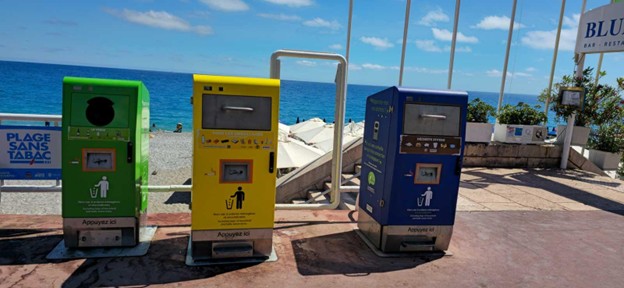
Métropole Nice Côte d’Azur uses environmental sensor networks and connected bins to modernise the way it manages public-space waste. Through the Monitoring Urbain Environnemental (MUE) project, almost 3 000 sensors have been deployed over 160 hectares in the Plaine du Var to collect data on air quality, noise, water, energy and the performance of services such as waste collection.
On the seafront, the city has introduced solar-powered compacting litter bins that transmit fill-level information and integrate ashtrays to capture cigarette butts and is progressively rolling them out along the Promenade des Anglais. Together, these initiatives show how a Mediterranean metropolis can use data and connectivity to reduce overflows, adjust collection rounds and cut emissions while preserving the attractiveness of a heavily visited coastline.
Challenges addressed
Métropole Nice Côte d’Azur must cope with strong seasonal pressure on public spaces, particularly along the Promenade des Anglais, where conventional street baskets can fill several times a day in summer and overflow quickly if collection is not finely tuned. At a metropolitan scale, collection rounds were historically based on fixed schedules rather than measured needs, which limited the capacity to adapt to peaks, optimise routes and control emissions. Before MUE, there was no continuous, detailed view of how quickly containers filled in different locations, and little data to evaluate the impact of new service patterns.
Sorting quality in recycling flows was also an issue, prompting interest in tools that could influence behaviour at the point of disposal. The smart-waste projects were designed to address both operational efficiency and environmental performance in this context.
Main objectives
The main objective is to monitor waste services in real time and adapt collection to actual needs in order to avoid overflowing bins, reduce unnecessary vehicle-kilometres and lower greenhouse-gas emissions while maintaining high standards of cleanliness.
MUE provides the métropole with a fine-grained evidence base on when and where containers need to be emptied, enabling experiments with new frequencies and routes. The compacting bins on the Promenade des Anglais aim to increase local storage capacity, limit litter dispersion and cigarette butts, and demonstrate how connected street furniture can relieve pressure on high-profile public spaces without multiplying collection trips.
External resources
Facts
Project type Environmental monitoring demonstrator (MUE) including indicators related to waste services, combined with connected public bins: solar-powered compacting litter bins with remote fill-level monitoring installed along the Promenade des Anglais.
Partners MUE is led by Métropole Nice Côte d’Azur and supported by industrial partners that contribute to the deployment and use of the sensor network and the metropolitan data warehouse. The compacting bins are implemented by the Ville de Nice and the métropole as part of their cleanliness and coastal-protection strategy, working with specialised suppliers of smart bins.
Funding MUE has a total budget of around EUR 1.7 million, co-financed by the European Regional Development Fund and local and national sources. The deployment of compacting bins on the Promenade des Anglais is financed from the city and métropole’s waste-management and coastal-protection budgets, with implementation staged over several years following an initial pilot.
Project description
Within the Plaine du Var eco-valley, the Monitoring Urbain Environnemental project has equipped roughly 160 hectares with around 3 000 sensors that measure air quality, noise, water and energy consumption, as well as aspects of service performance including waste collection.
Data from sensors placed on waste drop-off points are transmitted to the metropolitan data warehouse and used to test new collection patterns, for example by emptying only containers that are actually full. An external assessment indicates that this targeted approach has reduced greenhouse-gas emissions from waste collection operations by around 15 per cent. On the seafront, the city first installed three solar-powered compacting bins in 2021 for a six-month trial, then decided in 2022 to deploy fifty additional units along the Promenade des Anglais.
These bins compact waste up to tenfold compared to standard baskets, include large ashtrays and send real-time fill-level alerts to cleaning staff via mobile devices, allowing rounds to be planned on the basis of actual load rather than fixed frequencies.
Impact and results
MUE has given Métropole Nice Côte d’Azur a detailed and continuous view of environmental conditions and service performance in the Plaine du Var, including how often containers fill up and how collection rounds can be adjusted to save energy and reduce emissions.
In the waste sector, the use of sensors on drop-off points has enabled collection teams to focus on full containers and contributed to an estimated reduction of around 15 per cent in greenhouse-gas emissions from collection.
On the Promenade des Anglais, compacting bins have increased the effective capacity of litter receptacles, reduced overflow and cigarette litter and allowed the city to cut unnecessary vehicle trips while keeping a highly visible area clean during the tourist season.
Taken together, these initiatives show how an integrated smart-city strategy can turn waste data into operational decisions and climate benefits, and provide a replicable model for other coastal metropolises facing similar pressures.
These effects, combined with the visibility provided by İBB CepTrafik, have strengthened the city’s capacity to manage congestion with existing infrastructure and created a stronger internal culture of data-driven traffic management.
Publications & main documents
RELATED CONTENT
Sorry, no posts matched your criteria.