MOBILITY AND INNOVATION


AI-supported adaptive traffic management in Istanbul Metropolitan Municipality


Istanbul is a transcontinental metropolis of more than fifteen million residents, structured around bridges and narrow corridors where even small disturbances can trigger long queues. Independent assessments rank Istanbul among the most congested cities in the world, with recent estimates suggesting more than one hundred hours lost per driver each year.
Faced with the limits of adding new road capacity, Istanbul Metropolitan Municipality (IMM) chose to reorganise how it manages existing infrastructure. Through its Transport Department and Traffic Management Center, IMM has developed an in-house adaptive traffic management system, ATAK, which adjusts signal plans in real time based on live data from the field. This core system is complemented by the İBB CepTrafik service, which exposes traffic conditions to residents via web and mobile channels.
Together, these tools illustrate how a megacity can use data and algorithms to ease congestion, cut emissions and provide more predictable travel times without relying solely on new construction.
Challenges addressed
The initiative tackles several intertwined problems. Istanbul’s geography funnels large traffic volumes through a limited number of bridges and bottlenecks, so traditional fixed-time signal plans easily become misaligned with actual flows, especially during incidents or special events. Simply adding new lanes or structures is slow, expensive and often impossible in dense, historic areas.
Before ATAK, the city lacked a systematic way to translate detector data into coordinated signal adjustments across multiple junctions, and operators had limited tools to respond dynamically beyond manual interventions at individual sites. At the same time, drivers and public transport users had little visibility on current congestion and could not easily reroute around disruptions, which compounded delays and frustration.
The project, therefore, had to address both back-office optimisation and public-facing information, while building technical capacity within the municipality rather than outsourcing everything to vendors.
Main objectives
The primary goal is to reduce delay, queue lengths and travel-time variability on key corridors by using real-time traffic data to adapt signal timings continuously.
IMM also seeks to integrate junction control with its central Traffic Management Center so that operators can monitor conditions citywide, intervene quickly during incidents and coordinate interacting intersections instead of treating each signal in isolation. A further objective is to lower fuel consumption and emissions by cutting idling and stop-and-go traffic, and to improve the reliability of public transport services sharing the road network.
Finally, the project is intended to create durable in-house expertise in algorithmic traffic control and to provide residents with transparent, real-time information through İBB CepTrafik so that route choice can support, rather than undermine, network optimisation.
External resources
Facts
Project type Design, development and deployment of an in-house adaptive traffic signal control system (ATAK) integrated with the municipal Traffic Management Center, combined with a real-time traveller information service (İBB CepTrafik) that publishes congestion and camera feeds.
Partners The project is led by Istanbul Metropolitan Municipality through its Transport Department and Traffic Management Center. ATAK was developed within IMM, which coordinates with suppliers of detectors, controllers and communication infrastructure. The Traffic Management Center acts as the operational hub, where engineers and operators supervise network performance and manage responses.
Funding Financed primarily from IMM’s transport and information-technology budgets, with equipment and infrastructure investments phased over time as intersections are upgraded and connected. National programmes for intelligent transport systems can be used to complement municipal resources when available.
Project description
This project covers the idea of shelter in a scenario where not only the impact of temperatures on humans is resolved but also addresses this ecosystemic vision.
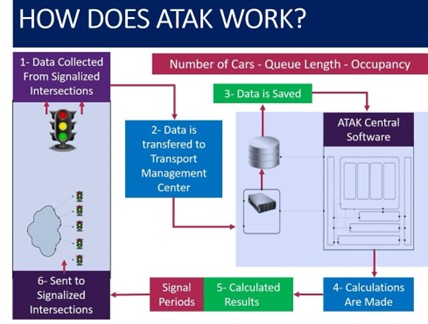
ATAK was developed by Istanbul Metropolitan Municipality’s Transport Department as an adaptive signal control system that uses real-time data from detectors at signalised intersections to update green times and cycles automatically.
Vehicle counts collected by sensors are sent to local controllers and then to a central optimisation engine in the Traffic Management Center, which recalculates signal plans and pushes them back to the field. The system was initially deployed at around eighty junctions on key corridors, with a phased plan to expand towards several hundred and ultimately all signalised intersections in the city.
In parallel, the municipality launched İBB CepTrafik to publish live congestion maps and camera images, allowing road users to see conditions and adjust their routes based on the same information used by operators.
Impact and results
Monitoring by the municipality indicates that intersections managed by ATAK experience noticeable improvements: average delays and travel times have fallen, traffic flow has increased and fuel use has declined on the equipped approaches.
IMM reports reductions in delay of roughly 15–30 percent, shorter travel times of about 20 percent and a cut in fuel consumption on the order of 15 percent, alongside significant monetary savings and an estimated 18 percent reduction in carbon emissions linked to smoother traffic.
These effects, combined with the visibility provided by İBB CepTrafik, have strengthened the city’s capacity to manage congestion with existing infrastructure and created a stronger internal culture of data-driven traffic management.
Publications & main documents
RELATED CONTENT
Sorry, no posts matched your criteria.