
• EN
LogoLogoLogoLogo Logo
 
  • Home
  • About
  • Cases
  • Voices
  • Tools
  • Contact
  • Home
  • About
  • Cases
  • Voices
  • Tools
  • Contact
  • Home
  • About
  • Cases
  • Voices
  • Tools
  • Contact
  • Environment & Climate Change
  • Waste
  • Energy
    • Rev’ACTE
  • City Strategies & Governance
  • Economic Development
  • Urban Planning
  • Mobility
    • UTC
  • Innovation
    • ProcuraMED
  • Culture & Identity
  • Social Rights

From door-to-door collection to Pay As You Throw in Argentona
  • ENVIRONMENT & CLIMATE CHANGE |
  • WASTE |
  • ENERGY |
  • CITY STRATEGIES & GOVERNANCE |
  • ECONOMIC DEVELOPMENT |
  • URBAN PLANNING |
  • MOBILITY |
  • INNOVATION |
  • CULTURE & IDENTITY |
  • SOCIAL RIGHTS

WASTE

Argentona introduced door-to-door collection (DtD) in 2004 and decided in 2010 to apply a Pay-As-You-Throw (PAYT) system with standard prepaid bags for citizens and commercial activities. DtDs and PAYT were extended to all suburban areas in 2016. PAYT was implemented using an initial participation process, an information campaign and a testing period. Permanent staff and the information office monitor the system and the users’ performance, which are key tools for the success of the system.

Tags: Waste management, collection, door to door, Pay As You Throw

Challenges addressed
  • The limitations of the collection system with a recycling rate that stagnated at less than 20%
  • No specific collection for organic waste
  • Most of the waste produced was disposed of by incinerator
  • The incinerator showed signs of saturation
  • Environmental concerns due to the proximity of the incinerator
  • Lack of social awareness and commitment on the issue of waste
Main objectives
  • Reduce the amount of waste produced by households and businesses, especially waste which is not recyclable
  • Implement a more efficient and economically attractive collection model for the municipality
Facts

Project type                                                                                     Waste management, waste collection


Implementing entity

Municipality of Argentona (Catalonia)

Funding

Municipality of Argentona (Catalonia)

Project description

Until 2004, the city of Argentona in Catalonia applied a common waste collection system in Spain, separating 4 types of waste: glass, paper, light packaging and residual waste. The recycling rate was low (less than 20%) and most waste ended up in the Mataró incinerator. Faced with the saturation of the latter, the city of Argentona decided to introduce a new collection system, door to door, introduced gradually and by means of an information and awareness campaign for the inhabitants. Following the introduction of this model, the recycling rate drastically increased. In 2012, it reached 68.5% on average.

Concretely, one type of waste is collected at home every day of the week, stream by stream, by rear-loading trucks. Residents take out their garbage at a specific time – between 8 and 10 p.m., with collection starting at 10 a.m. All waste is taken to a sorting center near Mataró, where neighboring municipalities collect their recyclable and residual waste to direct it to the appropriate factories.

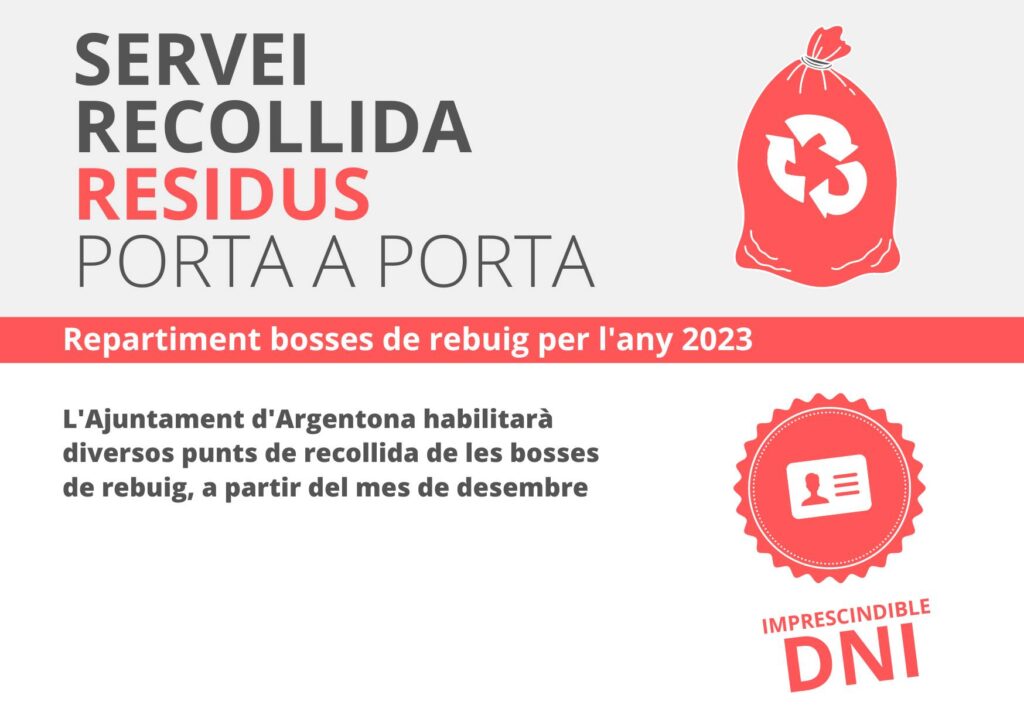
To continue to improve the rate of recycling and reduce the production of waste, the municipality of Argentona introduced, in 2009, a waste incentive pricing system, where people pay according to what they throw away, which rewards or economically penalizes households based on the amount of waste they produce. Before that, there was a fixed tax that was levied on all residents. Now the cost of waste management is covered by a combination of a fixed rate tax, which covers the partial fixed costs of the system, and a variable tax whose price is proportional to the amount of waste discarded. Furthermore, this PAYT system is based on the introduction of prepaid standard bags for residual waste (red) and light packaging (yellow), initially introduced for businesses and households. The yellow bags were then removed for citizens. PAYT is also applied for the organic fraction produced by companies. The municipality provides a number of bags included in the fixed part of the tax (1, 2 or 2.5 packets depending on the members of the household). Additional bags must be purchased from collaborating stores at a price of €0.65/17L bag. Companies must pay a fixed tax calculated according to the size of their premises and the type of activity they carry out and a variable tax according to the number of bags used for residual waste (2.5€/bag of 65L ) and light packaging (€1/100L bag).


Information sources : https://zerowastecities.eu/wp-content/uploads/2019/07/zero_waste_europe_cs2_argentona_fr.pdf

Impact and results
  • Between 2008 and 2018, the quantity of waste produced/capita/day decreased by 26% to reach 1.27 kg. Over the same period, the rate of selective waste collection rose from 52.8% to 87.6%. Residual waste decreased by 15% between 2009 and 2013 and packaging waste by 16%.
  • The quality of separately collected waste remained high.
  • The use of the municipal collection center increased.
  • The system was widely accepted by the majority of the population and was submitted to a wide political debate.
  • The number of jobs tripled, improving social inclusion and raising community awareness of the environment.
  • The municipality managed to save up to €35,000 per year.
Related documents

Interreg good practice factsheet on Argentona

Argentona website on waste collection

RELATED CONTENT


Governance Toolkit for managing Small-Scale Fisheries in Marine Protected Areas
Environment & Climate Change, Tools
Sustainable management of Posidonia beach systems
Environment & Climate Change, Tools
Wetlands Contract
Environment & Climate Change, Tools
TOOL: Co-designing built interventions with children affected by displacement (DeCID)
City Strategies & Governance, Tools,
Visualizing innovation in cities Guidelines
City Strategies & Governance, Innovation, Tools,
Waste Management in Amioun (North Lebanon)
Cases, Environment & Climate Change, Waste,
Missions València 2030: a mission-oriented strategy to drive urban innovation through Public Procurement of Innovation
Cases, City Strategies & Governance, Innovation, ProcuraMED, Public Procurement for Innovation,
Categories

CasesCity Strategies & GovernanceWaste

Tags
collection door to door Pay as you throw Waste Management
Share
  • Facebook
  • Twitter
  • Google+
  • LinkedIn

Legal mentions

contact@medcities.org


The Urban Transports' section is developed with the support of:

We value your privacy
We use cookies on our website to give you the most relevant experience by remembering your preferences and repeat visits. By clicking “Accept”, you consent to the use of ALL the cookies. However you may visit Cookie Settings to provide a controlled consent.
CustomizeReject AllAccept All
Manage consent

Privacy Overview

This website uses cookies to improve your experience while you navigate through the website. Out of these cookies, the cookies that are categorized as necessary are stored on your browser as they are essential for the working of basic functionalities of the website. We also use third-party cookies that help us analyze and understand how you use this website. These cookies will be stored in your browser only with your consent. You also have the option to opt-out of these cookies. But opting out of some of these cookies may have an effect on your browsing experience.
Necessary
Always Enabled
Necessary cookies are absolutely essential for the website to function properly. These cookies ensure basic functionalities and security features of the website, anonymously.
CookieDurationDescription
cookielawinfo-checkbox-analytics11 monthsThis cookie is set by GDPR Cookie Consent plugin. The cookie is used to store the user consent for the cookies in the category "Analytics".
cookielawinfo-checkbox-functional11 monthsThe cookie is set by GDPR cookie consent to record the user consent for the cookies in the category "Functional".
cookielawinfo-checkbox-necessary11 monthsThis cookie is set by GDPR Cookie Consent plugin. The cookies is used to store the user consent for the cookies in the category "Necessary".
cookielawinfo-checkbox-others11 monthsThis cookie is set by GDPR Cookie Consent plugin. The cookie is used to store the user consent for the cookies in the category "Other.
cookielawinfo-checkbox-performance11 monthsThis cookie is set by GDPR Cookie Consent plugin. The cookie is used to store the user consent for the cookies in the category "Performance".
viewed_cookie_policy11 monthsThe cookie is set by the GDPR Cookie Consent plugin and is used to store whether or not user has consented to the use of cookies. It does not store any personal data.
Functional
Functional cookies help to perform certain functionalities like sharing the content of the website on social media platforms, collect feedbacks, and other third-party features.
Performance
Performance cookies are used to understand and analyze the key performance indexes of the website which helps in delivering a better user experience for the visitors.
Analytics
Analytical cookies are used to understand how visitors interact with the website. These cookies help provide information on metrics the number of visitors, bounce rate, traffic source, etc.
Advertisement
Advertisement cookies are used to provide visitors with relevant ads and marketing campaigns. These cookies track visitors across websites and collect information to provide customized ads.
Others
Other uncategorized cookies are those that are being analyzed and have not been classified into a category as yet.
Reject All Save My Preferences Accept All
Powered by GDPR Cookie Compliance WebToffee Logo