
Extensive energy-efficient transformation of a prefabricated kindergarten building “Loptica’’ – City of Koprivnica, Croatia
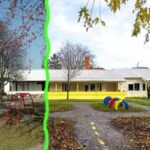
The pilot project for extensive energy efficient transformation of a prefabricated kindergarten building “Loptica” (820 m²); carried out for the city of Koprivnica in Croatia under the management of project partners City of Koprivnica and Regional Energy Agency North.
Challenges addressed
Prominent MED focused on small municipalities, which were considered as buyers and users of existing technology solutions/systems, which were not yet well diffused. The four municipalities involved in the project launched PPI for the renovation of their public buildings. One of them is the municipality of Koprivnica in Croatia. The pilot project in Koprivnica involves the energy-efficient renovation of a prefabricated kindergarten building (820 m²).
REA North, the partner of the City of Koprivnica, undertook market research to determine the possible market size for prefabricated buildings used as kindergartens and older than 25 years. Representatives of 127 cities in Croatia were interviewed. The research revealed that at least 25 similar buildings exist in Croatia, and none of these buildings have ever been renovated. Moreover, almost 60 cities and municipalities owning prefabricated or similar buildings, and other public business entities and faculties expressed their interest in the market engagement procedure.
Furthermore, the Ministry of Construction and Physical Planning recognised the importance of the pilot project and appointed its project team member. The Ministry indicated that it would closely monitor the pilot to assess the possibility of replication of this renovation approach not only to kindergarten buildings but also to similar ground-level buildings. These actions showed suppliers that they had an opportunity to develop and test new products or processes not only for this project.
It is crucial to exchange with end-users who can pinpoint the inefficiencies of the service/process that is delivered. Moreover, involving the end-user is important for the future implementation and acceptation of the innovation.
The municipality of Koprivnica involved two separate focus groups of end users in needs identification: one group gathering kindergarten personnel and another interested parents. Each group had to give answers based on previously prepared questions. Then, end-users were free to propose their ideas. All answers were documented and compiled. The municipality carried out detailed building construction analysis and simulation (a document with 70 pages) with the help of experts from the Civil Engineering Faculty to make sure the building was in proper condition.
Construction market players are usually fragmented and prefer detailed specifications. Moreover, many small- and medium-sized companies have no experience in public procurement, which may result in significant loss of opportunities for public authorities. Finding the right way to tap the market can be a real challenge. In this case, important resources have been devoted to the open market consultation (market engagement prospectus, emails to 15.000 addresses, telephone survey to establish the market size and calls to more than 120 municipalities, organisation of a workshop in Zagreb, etc.). Despite these efforts, just a few companies were interested and one took part in the negotiation.
Small-scale projects are not attractive to the market. Thus, it is necessary to be prepared for incremental rather than revolutionary proposals.
It seems necessary to choose the appropriate procedure in the call for tenders. In Koprivnica, the competitive procedure with negotiations was selected because, after the market consultation, the municipality knew which sort of technical solutions to implement. Moreover, the level of investment, which was much lower than European thresholds for works contracts (€5,350,000,) could imply the low interest of the market.
The support of external technical and legal consultants is necessary for public procurers with limited resources and knowledge. Moreover, PPI was completely new in Croatia. There was no possibility to rely on public authorities with similar experience.
Main objectives
The City of Koprivnica had the following needs:
- To deliver external, internal and functional building energy refurbishment and total transformation solution for the prefabricated kindergarten;
- To maximise energy efficiency in cost-effective way based on total cost of ownership;
- To significantly improve childcare, learning environment quality, indoor space functionality;
- To plan the refurbishment works during the summer break (2 months) since the building is occupied the rest of the year;
- To anticipate future development of the kindergarten as an institution;
- To propose scalable and replicable solutions to attract nationwide interest
External resources
Facts
Project type: Extensive energy-efficient transformation of a prefabricated kindergarten building through PPI.
Partners: City of Koprivnica (Croatia) and Regional Energy Agency North (Croatia) as project partners within PROMINENT project.
Dates 2024- 2026 (on going)
Funding : EU-funded project PROMINENT (within the MED Programme)- Total EU funding (amount): EUR 799 993.60
Project description
Before the start of this pilot project, the prefabricated wooden kindergarten building was considered to be near the end of its useful lifetime. The idea was to avoid the demolition of the kindergarten and thus also avoid the construction of a new building, which would be a substantial cost.
This is why the PPI process was chosen in order to try to find an innovative solution to enhance the building and extend its lifetime.
The award criteria were the following: Price 50 % – Warranty 20 % (up to 60 months) – Innovation criteria 30 %
“Warranty” was a criterion to evaluate a Defects Liability Security/Guarantee period duration offered by the bidders (cf. Table 4).
The innovation criterion was appreciated for two outcome-based requirements (measures 1 and 2):
- Measure 1: Remediation of all inadequate water supply and drainage system of the building taking into account all restrictions such as “no major invasive works in walls or floor”, “new installations must not be visible to users despite these restrictions”
- Measure 2: The thermal protection of building envelope taking into account that current wooden walls are not able to withstand normal load capacity, therefore it was necessary to propose innovative way of mounting and reinforcement.
Measures 3 to 8 were not included in innovative evaluation, but the preferred bidder was forced to implement them.
- Measure 3: Increase of the daylight illumination of rooms by increasing the transparency the canopy
- Measure 4: Didactic and learning elements as a part of new envelope
- Measure 5: Damaged internal walls remediation
- Measure 6: New final floor layer in children’s rooms
- Measure 7: High-efficiency heat energy production system
- Measure 8: Ventilation system with recuperation
Table: Award criteria calculation in Koprivnica
| CRITERIUM NAME | MEASURING UNIT | SYMBOL | RELATIVE % | METHODOLOGY | POINTS |
| The Price | The price without VAT; calculated up to two decimal places [0,00] | C | 50,00% | CPmin = lowest bidder’s price offered
CP = price of currently evaluating bid 50,00 = the relative importance of this criterium |
Score is calculated as follows: |
| Innovative Specification Of Measure 1 | Innovative features offered?
YES / NO |
MI1 | 15,00% | NO | 0,00 |
| YES | 15,00 | ||||
| Innovative Specification Of Measure 2 | Innovative features offered?
YES / NO |
MI2 | 15,00% | NO | 0,00 |
| YES | 15,00 | ||||
| Warranty Period | In months; in whole numbers, without decimal places | J | 20,00% | 24 months | 0,00 |
| 25 up to 29 months | 2,50 | ||||
| Od 29 up to 34 months | 5,00 | ||||
| Od 35 up to 39 months | 7,50 | ||||
| Od 40 up to 44 months | 10,00 | ||||
| Od 45 up to 49 months | 12,50 | ||||
| Od 50 up to 54 months | 15,00 | ||||
| Od 55 up to 59 months | 17,50 | ||||
| More than 60 months | 20,00 | ||||
| MAXIMUM COMBINED SCORE | 100,00% | 100,00 | |||
| COMBINED SCORE IS CALCULATED AS FOLLOWS:
E = C + MI1 + MI2 + J |
|||||
It was possible to offer Measure 1 and/or Measure 2 without innovative features (as usual solutions) and in this case they were not evaluated. This was allowed to avoid stopping the project (it showed that the Croatian market is not yet prepared for this type of procurement). Moreover, contracting authorities did not want to promote innovation for the sake of innovation.
If Measure 1 and/or Measure 2 were offered with innovative characteristics, they had to meet or exceed requirements for innovative solution. For instance, for the measure to be regarded as innovative it had to meet at least:
- Measure 1: A) No invasive works in internal or external walls, except works in bathrooms. B) Minimal invasive work for new drainage system. C) No raising of the existing level of ground floor in order to carry out the plumbing and drainage system. D) Newly installed water supply system (pipes) and drainage system shall not be visible to occupants.
- Measure 2: A) Implement thicker thermal protection than possible since 75 % of external walls are wooden and hollow (sandwich walls). The maximum thickness is calculated in static analysis document issued by Faculty of Civil Engineering. B) Works must be organised to allow kindergarten to be in basic function for the users during June and from the last week of August onward.
The bidders had to describe their innovative solutions for Measure 1 and/or Measure 2 as pure technical specifications. These specifications were then evaluated as appropriate or not appropriate by Joint Evaluation Team (national procurement and technical expert).
A consortium gathering two construction companies and one designer was the only bidder. It proposed innovative solutions for thermal insulation of the building’s external envelope and reconstruction of building water supply and drainage system. This consortium took part to the visit and the market consultation workshop.
The selected bidder met all the requirements for innovative solutions. Both “Measure 1” and “Measure 2” were innovative:
Measure 1: Remediation of all inadequate water supply and drainage system of the building:
- Complete replacement of all inadequate water supply pipes and installation of new water supply without invasive works – by constructing the water supply network in the attic and connecting it vertically down directly to bathrooms and kitchen. In this way the new system is invisible to occupants and there was also no need for supporting structure, which proved to be cost effective for the selected bidder.
- Installation of completely new internal drainage/sewage system without replacement of an old one, using only minimal invasive works in a synergy with floor reconstruction. The drainage system was laid in one common narrow route throughout the building, with only one exit tube to connect to external drainage (instead of previous three exit tubes).
Measure 2: The thermal protection of building envelope:
- Implementation of the thicker-than-possible thermal protection of external walls. The solution was possible due to proposed reinforcing of the exterior walls construction by using OSB panels. The OSB panels enabled additional load capacity, a possibility to properly anchor the ETICS facade and to install PVC windows according to RAL standard.
The overall conclusion is that the innovation resulted from the combination of existing materials and basic techniques. The implementation approach was not previously offered or used in Croatia, which was confirmed to be true by national technical expert from the Faculty of Civil Engineering.
Contract value: 370.000 € (VAT included – 2.2 million HRK) – 200.000 € (Prominent MED budget) 170 000 € (City of Koprivnica)
Impact and results
The pilot project delivered an innovative and replicable concept for external, internal, energy-efficient, and functional transformation of a prefabricated wooden kindergarten and the concept was then implemented as a final solution on the same building.
The final solution was a completely transformed kindergarten building with an extended lifetime of 25+ more years for the cost of less than 500,00 € per square meter, which is less than 50 % of the cost of a new kindergarten building in Croatia (price without roof and interior equipment costs). The solution also resulted with 61 % savings on heating energy, 66 % savings on primary energy, and 66 % less CO2 emissions, all per year.
Finally, instead of demolishing the old building and constructing new one, one more goal was achieved along the way. By transforming and upgrading the building which was considered to be near the end of its useful lifetime municipality of Koprivnica and REAN diverted from landfill the whole building with a net area of 820 m2 from landfill, thus contributing to general local sustainability.