Waste, environment and climate change, social rights

Waste to Positive “Energy” in Jordan
Since the outbreak of civil war in Syria in 2011, some 6.6 million people have been displaced within their own country, while around 4.8 million have fled Syria, mostly to neighbouring countries. Jordan alone is hosting more than 655,000 Syrians, according to the United Nations High Commissioner for Refugees (UNHCR). However, unofficial estimates indicate that the real figure is considerably higher. Some suggest that Jordan’s population has increased by at least 10% because of the arrival of large numbers of refugees from Syria.
This population increase is putting a strain on host municipalities, which are no longer able to deliver adequate public services. Waste disposal systems, which were insufficient even before, are under pressure because of the higher volume of waste. According to a study by the United Nations Development Programme published in 2014, the daily volume of waste generated in Qasabat municipality in northern Jordan has increased from 300 tonnes to more than 500 tonnes, posing major disposal problems for the municipal authorities. The resulting build-up of waste puts health at risk and, in a worst-case scenario, can lead to outbreaks of cholera, hepatitis A, and typhoid. This is a difficult situation for everyone, with the potential also to trigger conflicts between local communities and Syrian refugees.
Challenges addressed
- Social cohesion between Jordan population and Syrian refugees in dealing with waste management.
- Reduction of health risks related to diseases that can be caused by the presence of unmanaged waste.
Main objectives
- Fostering labour-intensive collection and processing of recyclable waste to reduce potential for conflicts and the environmental impact in host communities.
External resources
Facts
Project type Waste management in conflict and migration contexts and Social cohesion
Partners
- Lead executing agency: Jordanian Ministry of Municipal Affairs (MoMA)
- Commissioned by: German Federal Ministry for Economic Cooperation and Development (BMZ)
- Deutsche Gesellschaft für Internationale Zusammenarbeit (GIZ) GmbH
Dates 2015-2017
Funding German Federal Ministry for Economic Cooperation and Development (BMZ)
Project description
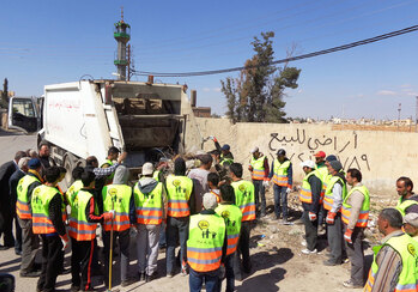
In around 22 Jordanian municipalities, including Irbid (MedCities member city), as well as refugee camps and recreational areas, Jordanian and Syrian workers are collecting and separating waste and processing the precious resources that it contains. This eases the burden on the municipalities, improves hygiene and curbs the spread of diseases.
On behalf of BMZ, the GIZ GmbH and its local partners provide work, train workers in waste separation and management and supply them with essential equipment, such as carts and compactors. GIZ also ensures compliance with workplace health and safety regulations. For example, all workers must be immunised and wear protective clothing. Waste disposal workers are employed either full- or part-time or daily. These various employment options are open to both local residents and Syrian refugees. By working together, the two communities are building closer relations, which helps to prevent conflict.
In addition, all residents in the municipalities can make a long-term contribution to waste avoidance by attending events where they learn more about recycling, environmental protection, health and hygiene and by joining working groups that offer opportunities for discussions with experts.
The project is part of the BMZ special initiative ‘Tackling the Root Causes of Displacement, Reintegrating Refugees’, which provides short-term support to refugees and their host communities. In the long term, sustainable measures are designed to eliminate the structural causes of displacement, such as social inequality and food insecurity. This project helps to provide work for refugees and host communities and promotes social cohesion, health and sustainable regional development.
Impact and results
- The work is labour-intensive and was employing around 6,000 Syrians and Jordanians in 2016 alone. In addition to earning an income, these workers benefit from training opportunities.
- Besides providing employment and skills, the project supported, from 2015 until the end of 2017, a range of partners (political institutions, private households, community representatives, companies and business start-ups) to ensure that recycling and waste reduction activities were both successful and sustainable.
- In the host communities in Irbid and Mafraq, it was identified a potential for producing 1,000 tonnes of compost and the possibility to collect 150 tonnes of paper and cardboard and 120 tonnes of plastic waste per month. Moreover, each worker was supplied with gloves, a protective jacket and waste collection equipment, such as brooms, pickers and carts. Waste disposal vehicles and bins, containers, recycling points and composting facilities were provided for some municipalities.
RELATED CONTENT
Sorry, no posts matched your criteria.